
Prospect Watch-Dylan Dreiling
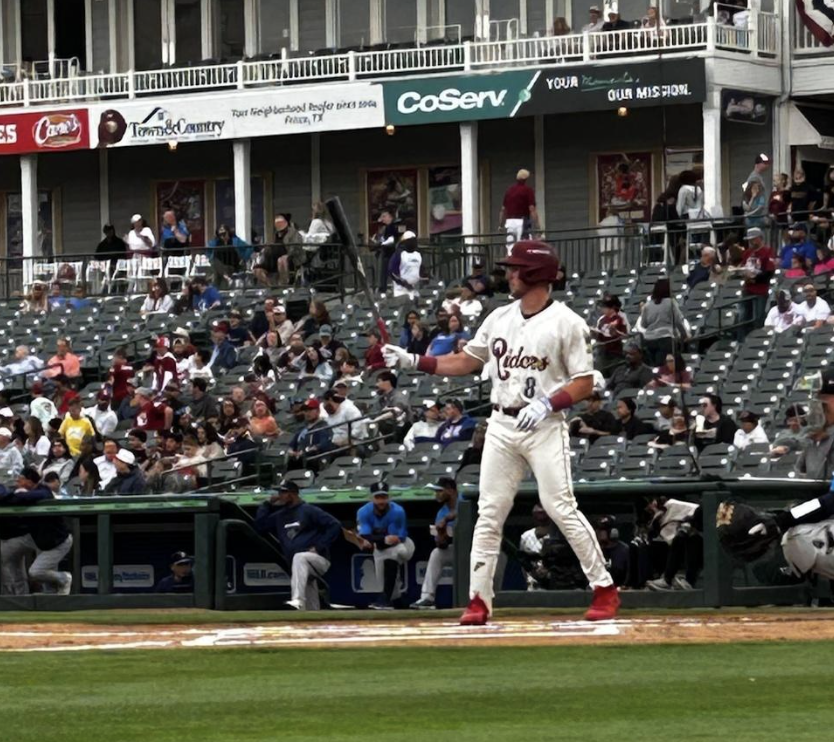
Dylan Dreilling, the Texas Rangers # 10 Prospect, readies for his first at-bat in Double A Baseball at home
Before Dylan Dreiling ever saw a professional pitch, he saw his grandfather throw one.
Old school baseball, as Dreiling describes it. Swing the bat. Make contact. The grandfather who handed him the game didn't have much patience for passive at-bats, and neither did the father who spent summers firing batting practice in the backyard. The message was simple: put the barrel on the ball, every single time.
Dreiling is 22 years old now and starting Opening Day 2026 at Double-A Frisco. The philosophy has stuck. What has changed is everything around it.
The number that doesn't fit the age
Last season at High-A Hickory, Dreiling posted a 5.6 percent swinging strike rate across 483 plate appearances. That figure isn't just good for a 22-year-old in his first full professional season. It's elite by any standard at any level of affiliated ball.
For context: the average MLB hitter swings and misses roughly 11 percent of the time. A 5.6 mark at High-A suggests a hitter with an unusually refined sense of the zone, one who can chase the swing, recognize the break, and lay off without losing his aggressiveness.
Dreiling doesn't treat it as a mechanical achievement. When asked whether that contact avoidance is something he consciously pursues, he traces it back to the backyard.
"Granddad was old school baseball," he said. "He emphasized swings and ball contact. Dad spent summers throwing BP. Swing, swing." He made an effort, he says, to put the bat on every pitch that came near him. The low miss rate is less a product of discipline than of repetition deep enough to become instinct.
What makes the number more interesting is the company it keeps. In the same season, Dreiling walked 12 percent of the time and struck out in 20.9 percent of plate appearances. That combination, a walk rate that high alongside a SwStr% that low, points to a hitter who knows exactly where the strike zone ends. He isn't just making contact because he swings at everything. He's making contact because he swings at the right things.
The swing that changed
The batted ball profile from 2024 to 2025 tells a clear developmental story. In his first 24 games at High-A, Dreiling was a groundball hitter. His GB rate sat at 42.4 percent. He pulled the ball 35.8 percent of the time. He hit one home run.
A year later, the profile had shifted. His groundball rate dropped to 35 percent. His fly ball rate climbed to 39.1 percent. He hit 12 home runs and posted an ISO of .155, nearly double his 2024 mark.
The mechanical explanation, in his own words, is precise: "Swinging up, making an effort to put more backspin on the ball and drive it. Trying to loft it more over the shortstop."
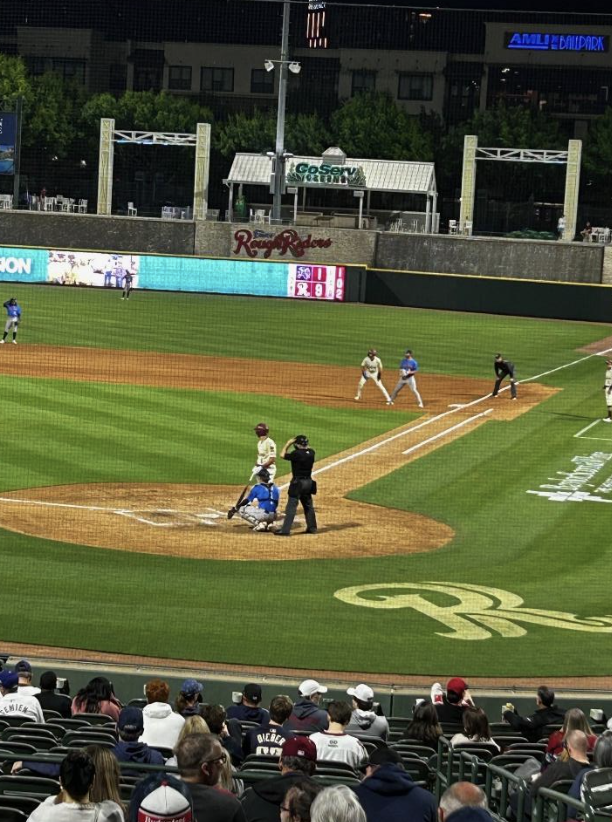
With Jake Snider on first, Dreiling steps up to the plate in the bottom of the seventh inning in his home debut at Double A Frisco
That phrase, over the shortstop, is the key. It isn't about pulling everything in the air or swinging for the fences. It's about attacking the opposite-field gap with lift, which requires both bat speed and a hitter confident enough in his hands to let the ball travel. The power production last season wasn't accidental. It was the result of a deliberate adjustment that held across 483 plate appearances.
The profile that emerged, 12 home runs, 15 stolen bases, a 12 percent walk rate, and a 107 wRC+ in a full High-A season, doesn't show up often in the same player. Power-speed combinations with genuine plate discipline tend to appear in prospect rankings, not quietly in Hickory box scores.
What Double-A asks of him now
The jump from High-A to Double-A is where prospect profiles either sharpen or fray. Pitchers throw with more deception, sequences get more complex, and the margins for error shrink on every borderline pitch. Dreiling arrived in Frisco off what he calls a good showing in Corpus Christi during spring, and he's clear about what he wants to prove.
"Keep working on contact and driving the ball to the backside," he said. The answer is less about proving something to evaluators and more about continuing the thread that ran through 2025: controlled aggression, backspin, oppo-field lift.
The context that surrounds him matters too. Chad Comer has been his professional manager since the day he was drafted in the second round of the 2024 draft out of Tennessee. That continuity, same voice, same expectations, same vocabulary across two levels, is something Dreiling points to directly when asked about the pace of his development.
"The timeline is fast, but I've had great coaches," he said. "Chad has been my coach since I got drafted. It's been really great, knowing what to expect."
That stability shows in the data. Hitters who develop quickly under consistent instruction tend to internalize adjustments rather than just execute them. The swing-path change that powered Dreiling's 2025 didn't appear to regress even in the final months of the season, which suggests it's real, not a hot streak.
Opening Day
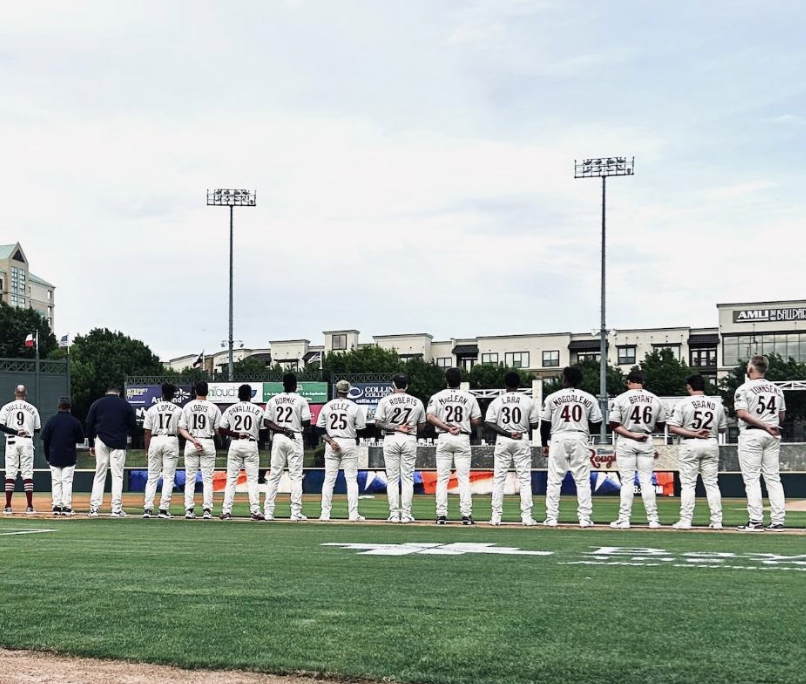
Opening Day Festivities at Rider Park in Frisco, Texas
On a warm and breezy Tuesday night in April, Frisco's Rider Ballpark had fans streaming in from all the gates to see the home opener for the club. Chatter was high, excitement was palpable. Dreiling described the feeling of being in that clubhouse on April 7, 2026 the way a 22-year-old should: "Amazing. Being here is incredible."
The prospect report gives him a 40-plus future value with a 2027 ETA. The tools are real: 55 raw power, 55 speed, a contact profile that most hitters spend careers trying to build. The questions are the ones Double-A is designed to answer, whether the walk rate stabilizes as velocity and movement sharpen, whether the fly ball approach holds against pitchers who can actually execute a plan.
His grandfather told him to swing. His father told him to make contact. The coaches added the angle, the backspin, the intention.
The data says the lesson took.
Dylan Dreiling stats sourced from FanGraphs minor league database. Interview conducted April 7, 2026 at Riders Ballpark, Frisco, Texas. Photos and interview by Pete Dwyer
About the Author
The Baseball Nerd launched in early 2025 with a simple philosophy: stories based on numbers, not feelings. Combining proprietary metrics like the SPARK Score (for identifying breakout candidates) and the FADE Score (for predicting regression) with accessible storytelling, he serves both serious sabermetrics enthusiasts and casual fans looking to understand the game at a deeper level. His Sunday Stories explore baseball history through approachable narratives, exploring the personal side of baseball with historical and lost stories; while his in-season coverage focuses on the Texas Rangers. You can find his work at The Baseball Nerd, where analytics meet narrative in a way that makes the numbers come alive.