
The Tigers Built a Rotation That Will Dominate the American League
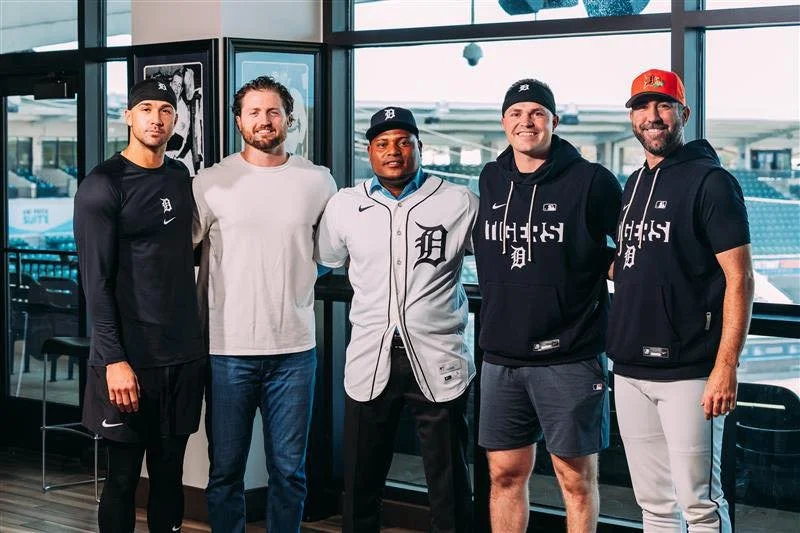
Tigers Pitching Staff 2026 (Brad Galli WXYZ)
The Numbers Prove It Isn’t Even Close
As pitchers and catchers are now reporting for Spring Training, the Detroit Tigers possess the most dominant starting rotation in baseball – not the best, not just really good – dominant. We’re talking about the kind of advantage that wins championships in October. This is a deep dive into pitching staffs of the American League even close to comparable to that of Detroit.
This isn't hyperbole driven by offseason excitement. This is the calculus of running every American League starting pitcher through the SPARK and FADE scoring methodologies. Detroit's projected rotation carries a combined Pitcher Value of 463.0 across their top five starters. Second place Seattle sits at 385.0, trailing by 78 points. Tampa Bay, in third place, falls 100.6 points behind. The gap between Detroit and everyone else isn't competitive. It's a chasm that gets wider the deeper you look.
The additions of Framber Valdez and Justin Verlander didn't just improve Detroit's rotation, they created something that doesn't exist anywhere else in the American League right now: four consecutive starting pitchers all carrying FADE scores of 0.0, meaning the methodology found zero decline indicators across every metric measured. No regression signals or aging concerns despite Verlander being long in the tooth. No warning signs buried in the peripherals. Just sustained performance backed by skills that show no signs of eroding.
Understanding the Numbers
The SPARK and FADE scoring systems measure everything that matters for pitcher evaluation. SPARK identifies breakout candidates aged 20-27 through weighted components measuring performance metrics, skill development, workload management, and contextual factors. Higher scores indicate positive progression trajectory and elite upside potential.
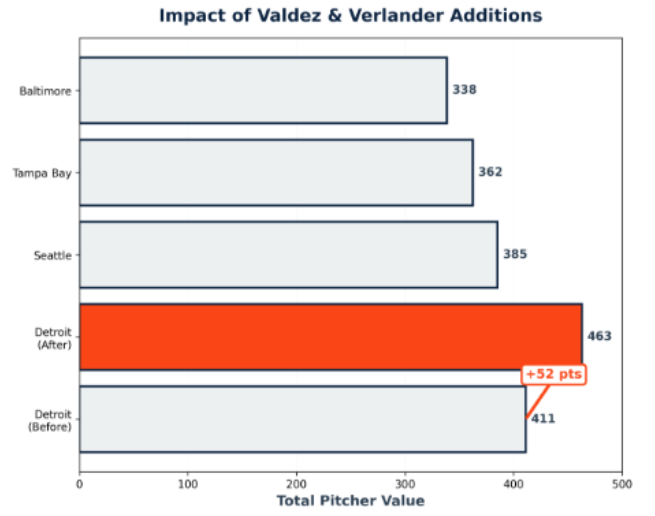
Detroit’s Total Pitcher Value After Addition of Valdez and Verlander (Baseball Nerd)
FADE works as the inverse for pitchers 28 and older. It stands for Future Attrition and Decline Evaluation, measuring regression risk through performance trajectory, skill erosion, stuff degradation, contact quality indicators, and workload sustainability. Lower FADE scores mean aging well. Higher scores signal incoming decline. A perfect score of 0.0 means the methodology found nothing suggesting regression. A score of 100.0 means the pitcher should retire immediately.
For veteran pitchers, we invert their FADE score to create a unified Pitcher Value metric. A FADE score of 0.0 becomes a Pitcher Value of 100.0. A FADE score of 50.0 becomes a Pitcher Value of 50.0. This lets us compare young arms with breakout potential against aging veterans maintaining peak performance on equal footing.
Detroit's rotation features four consecutive Pitcher Values of 100.0 followed by a 63.0 from Verlander. That 463.0 total represents the highest combined value in baseball by a margin that defies competition.
Tarik Skubal Is the Best Pitcher in Baseball
Starting at the top, Tarik Skubal led Major League Baseball with 6.6 WAR in 2025 while posting a 2.21 ERA backed by a 2.66 xFIP. That ERA isn't luck-based outperformance; his skills support the results completely.
His 27.8 percent K-BB rate separates good pitchers from elite ones. He's striking out more than a quarter of the batters he faces while barely walking anyone. When you combine that level of command with stuff that grades out at 116 Stuff+ and 119 Pitching+, you eliminate vulnerability to regression. The fastball plays up because he commands it to both sides of the plate. The slider generates whiffs because hitters can't sit on anything. His repertoire isn't one elite pitch propping up the rest, everything works.
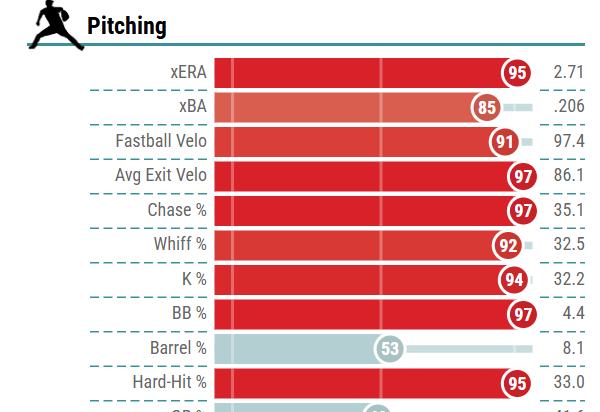
Tarik Skubal Pitching Metrics (Baseball Savant)
Skubal carries a FADE score of 0.0 at age 29, which makes perfect sense when you examine the underlying data. There's no velocity decline, his breaking ball hasn't lost bite, his command hasn't eroded, and contact quality against him remains elite. He's not getting lucky with BABIP or strand rate, he's just operating at the absolute ceiling of modern pitching dominance while entering his peak years.
The FADE methodology examines dozens of indicators that typically signal incoming regression for pitchers in their late 20s. It found nothing with Skubal. Zero red flags. Zero warning signs. Just a pitcher performing at an elite level with skills that support continued excellence.
Framber Valdez Defies Age at 32
Valdez posted 4.0 WAR at age 32 with a FADE score of 0.0, which shouldn't be statistically possible, but here we are. Most pitchers at 32 show some decline indicators – velocity drops a tick, breaking balls flatten slightly, command becomes less consistent – the FADE methodology measures all of it, and Valdez passes every test.
His stuff grades at 108 Stuff+ while his Pitching+ sits at 109, meaning he's generating above-average results through both pitch quality and execution. He pounds the strike zone relentlessly with a sinker that generates ground balls at elite rates. His 14.8 percent K-BB rate isn't Skubal-level dominance, but it demonstrates exactly the kind of command necessary to sustain performance into your 30s.

Framber Valdez Stuff+ Metrics (Fangraphs)
His 3.66 ERA sits higher than ideal for a number two starter, but the 3.34 xFIP suggests he's pitching better than the ERA indicates. When your expected metrics show better performance than your actual results, that's the opposite of a decline signal. That's a pitcher who should improve with regression to the mean working in his favor rather than against him.
Valdez's FADE score of 0.0 represents one of the most impressive aging profiles in baseball. He's maintained stuff quality, improved command, and shows zero evidence of the physical decline that typically destroys pitchers in their early 30s. Detroit didn't just acquire a veteran arm to eat innings, they added a pitcher still operating at peak effectiveness with no statistical indication that's about to change.
Justin Verlander Adds Elite Depth
Then, Detroit signed Justin Verlander, because apparently having four perfect FADE scores wasn't enough.
At 43 years old, Verlander carries a FADE score of 37.0, which represents moderate decline risk under the methodology. His age alone adds 25 points to the score before evaluating any performance metrics. What makes this signing remarkable is he still generates quality swing and miss with 106 Stuff+ and a 20.7% K Rate in 2025. The fastball hasn't abandoned him. His breaking balls still generate whiffs. He posted 2.2 fWAR across 152 innings in 2025, proving he can still eat innings effectively at the major league level.
The concerns are real. Verlander’s 7.9% BB rate signal command erosion. The 93 Location+ confirms he's missing spots more frequently. His 3.85 ERA sits nearly a full run better than his 4.57 xFIP, suggesting significant regression incoming as the ERA-xFIP gap closes. When you're running that hot on sequencing luck while walking too many batters, the bottom tends to fall out quickly.
For any other American League team, a 43-year-old with a FADE score of 37.0 would be a massive concern. For Detroit, he's their fifth starter. Their weak link. The guy who might regress to replacement level, at which point they can slot in Reese Olson or tap into their organizational depth without missing a beat.
Verlander's Pitcher Value of 63.0 absolutely crushes what Reese Olson brought at 11.0, adding 52 points to Detroit's rotation total. That's the gap between Detroit and Seattle right there, absorbed in one signing. The Tigers didn't need Verlander to have the league's best rotation. They signed him anyway because the opportunity existed to extend an already insurmountable advantage.
The Five Horsemen Create an Unprecedented Advantage
Jack Flaherty earned his FADE score of 0.0 through one of the best reclamation projects in recent memory. He posted 2.5 WAR with a 3.69 xFIP and 18.9 percent K-BB rate while his stuff metrics sit right at league average. That doesn't sound dominant until you realize that perfectly average stuff with above-average command makes you a reliable number three starter, and his peripherals show zero decline indicators at age 30.
Casey Mize completes the group at 2.4 WAR with a FADE score of 0.0, which validates everything Detroit's medical and coaching staff accomplished getting him healthy. His 16.4 percent K-BB rate demonstrates improved command. His 96 Stuff+ and 103 Pitching+ show the repertoire plays effectively. At 28, he's positioned perfectly for peak performance years with no lingering injury concerns detected by the methodology.
Four consecutive FADE scores of 0.0 doesn't happen by accident. It represents exceptional talent evaluation, aggressive roster construction targeting specific profiles, and organizational execution across medical staff, coaching, and player development. Detroit identified pitchers with elite skills showing no decline signals, then acquired them before the market fully recognized their value.
The Best of the Rest of the American League
Seattle's rotation carries a Total Value of 385.0, which represents genuinely excellent construction. Bryan Woo provides legitimate breakout potential with a SPARK score of 21.0 at age 26. Logan Gilbert posted a microscopic 2.95 xFIP with an elite 26.5 percent K-BB rate while earning a perfect FADE score. Luis Castillo and George Kirby both show zero decline signals despite being on the wrong side of 28. This is a very good rotation.
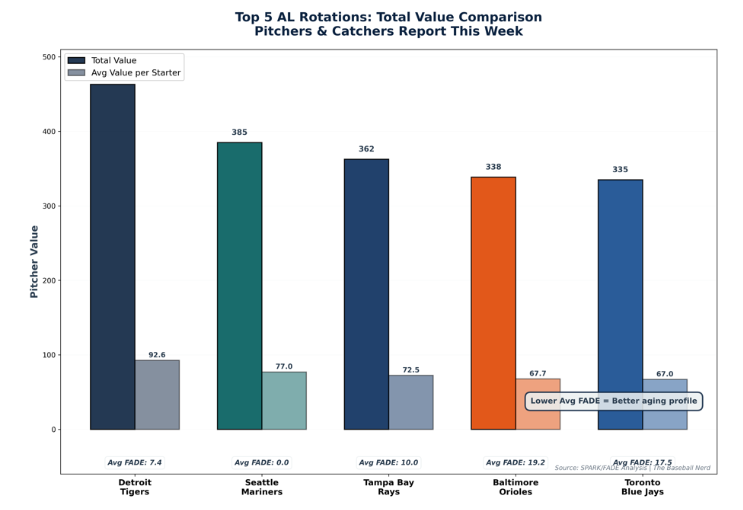
Total Value Comparison of Top 5 AL Rotations (Baseball Nerd)
Logan Gilbert is excellent. However, Seattle's depth falls off after the top four, and they lack the same elite ceiling at the front. That 78-point gap represents real wins over 162 games and the difference between advancing in October or watching from home.
Tampa Bay sits third at 362.4 Total Value, built around elite stuff metrics. Drew Rasmussen, Ryan Pepiot, and Shane McClanahan all feature Stuff+ ratings above 109, creating massive strikeout upside. But their average FADE score of 10.0 reveals early decline signals across the group. More importantly, their injury histories create innings volatility that Detroit simply doesn't face with four healthy starters showing zero decline indicators.
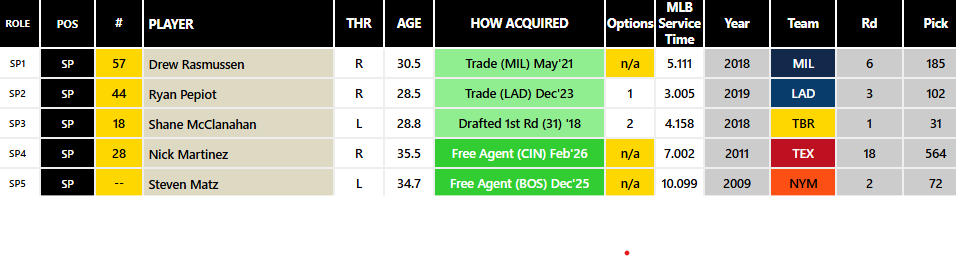
Rays Starting Pitching Depth (Fangraphs)
Baltimore features Kyle Bradish with a perfect FADE score and 3.9 WAR, giving them a legitimate ace. Then Zach Eflin shows up with a FADE score of 60.0, negative WAR, and declining peripherals across every category measured. You can't win championships when your fifth starter shows severe decline indicators. Detroit doesn't have that problem.
Toronto built around Kevin Gausman and Dylan Cease, both earning perfect FADE scores at the top of the rotation. But José Berríos sits at FADE 50.0 while Shane Bieber carries a 20.0, meaning two starters are fighting age curves simultaneously. Detroit has zero pitchers dealing with that through four starters.
The Yankees roster has Max Fried with a perfect FADE score, then nothing but unproven lottery tickets behind him until Garrit Cole gets back sometime in late May or early June. One early-season injury will put them in a catastrophic rotation depth crisis.
Cleveland is running out five pitchers with SPARK scores hovering between 11 and 13, which means potential without results. That's organizational depth cosplaying as a major league rotation.
None of these American League teams can match four consecutive perfect aging profiles backed by elite performance. None of them have the depth to absorb injury without value collapse. None of them can run out their ace on short rest knowing three other zero-decline starters are waiting behind him.
The Playoff Math Works Perfectly
In a five-game Division Series, Detroit throws Skubal in Game 1, Valdez in Game 2, Verlander in Game 3, Flaherty in Game 4, and Skubal again in Game 5 if necessary. That's two starts from the best pitcher in baseball backed by three more from pitchers showing zero decline indicators.
In a seven-game Championship Series, Skubal goes Games 1, 4, and 7. Valdez takes Games 2 and 5. Flaherty handles Games 3 and 6. They don't even need Mize or Verlander to navigate through October. Those guys are depth pieces. They’re insurance against injury and luxury options most teams would kill to have as their number two starter.
Compare that to what Seattle faces – they need Bryan Woo's breakout to materialize immediately and hope their veterans maintain form. Baltimore needs Zach Eflin to stop declining while praying Kyle Bradish stays healthy. Toronto requires both Bieber and Berríos to simultaneously fight off Father Time. The Yankees need everyone healthy because their depth chart is terrifying.
The Only Caveat Is Injury
The singular argument against Detroit dominance is injury fragility, an even more pronounced risk with Reese Olson now out for the year. Valdez, Flaherty, Mize, and Verlander all carry some injury history in their medical files. If two starters hit the injured list simultaneously, that 463.0 Total Value starts eroding quickly as you dip into organizational depth.
If the Yankees lose Max Fried, they're running out Will Warren with zero track record. Cleveland already has five unproven starters in their rotation by design. Baltimore's depth chart after five is legitimately frightening. Tampa Bay's injury history creates constant rotation volatility.
Injury risk is universal in baseball. The depth and talent to handle it without catastrophic value loss is not. Detroit built both.
Domination Doesn't Require Luck
Detroit's rotation advantage isn't about hoping young arms break out or praying veterans maintain form. It's about statistical certainty backed by measurable skills. The FADE scores don't project decline where none exists. The metrics don't lie about stuff quality or command sustainability. The numbers say Detroit dominates, and domination built on elite performance with zero regression signals doesn't require luck to manifest.
Tarik Skubal is the best pitcher in baseball by measurable results. Framber Valdez defies aging curves at 32. Jack Flaherty completed his bounce-back. Casey Mize is finally healthy. Justin Verlander at 43 with moderate decline risk serves as their luxury fifth starter, a role that would be laughable for any other organization.
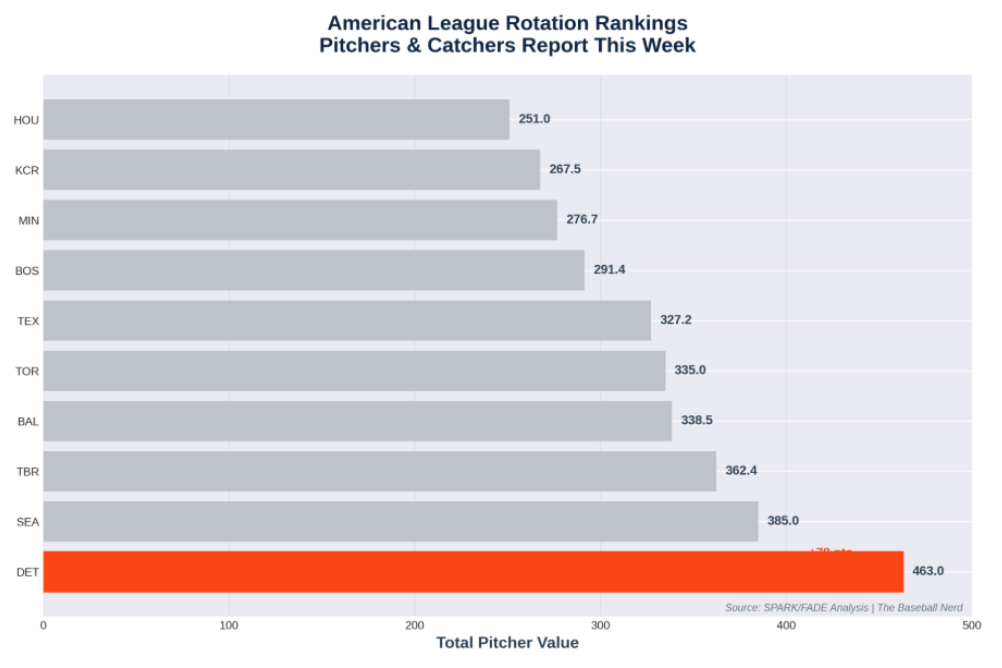
American League Pitcher Rotation Rankings (Baseball Nerd)
The rest of the American League is fighting for second place. Some teams have built good rotations. Seattle's is excellent. Tampa Bay has elite stuff. Baltimore features a legitimate ace. None of them can match four consecutive perfect aging profiles. None of them have the depth to weather injury. None of them possess the same combination of elite ceiling and sustainable performance.
Pitchers and catchers report this week around the league. The Tigers are already in mid-season form, armed with statistical evidence that their rotation will dominate throughout the season and into October. Everyone else is trying to catch up to a team that added Justin Verlander to a rotation that didn't need him.
The numbers don't lie. Detroit built something unprecedented. The rest of the American League can hope for injury luck or pray for career years from unexpected sources. The Tigers will be counting wins while everyone else counts excuses.
This is what domination looks like when you build it deliberately, measure it objectively, and execute it perfectly. Detroit did all three. The American League is about to find out what that means.
About the Author
The Baseball Nerd launched in early 2025 with a simple philosophy: stories based on numbers, not feelings. Combining proprietary metrics like the SPARK Score (for identifying breakout candidates) and the FADE Score (for predicting regression) with accessible storytelling, he serves both serious sabermetrics enthusiasts and casual fans looking to understand the game at a deeper level. His Sunday Stories explore baseball history through approachable narratives, exploring the personal side of baseball with historical and lost stories; while his in-season coverage focuses on the Texas Rangers. You can find his work at The Baseball Nerd, where analytics meet narrative in a way that makes the numbers come alive.