
Why Can’t the Texas Rangers Stay Healthy?
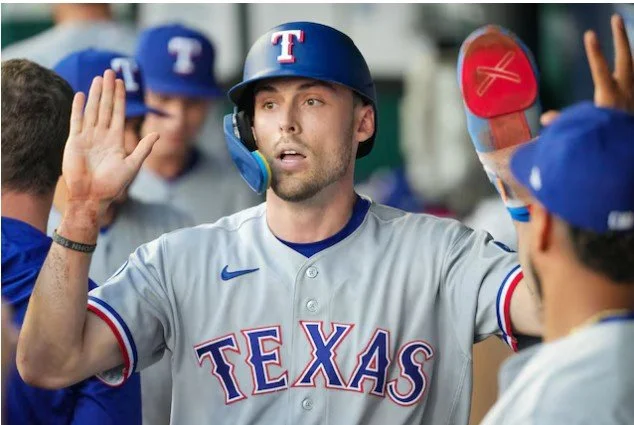
Evan Carter of the Texas Rangers
Could the Real Texas Rangers Team Please Stand Up?
Corey Seager comes back, then his back becomes the story again. Wyatt Langford starts looking like the bat that could change the lineup, then another injury cuts into the breakout. Evan Carter returns, but the outfield still never quite settles. Around them, Josh Smith’s season gets chopped up, Chris Martin’s shoulder becomes a recurring bullpen issue, and the roster keeps moving before the Rangers can find rhythm.
This is not just an injury problem, although it is easy to categorize it that way. The team has no discernable continuity. The identity of this team changes on a weekly basis. The whole season keeps coming back to this one uncomfortable question – why can’t the Rangers stay healthy?
The injuries keep hitting the structure
Every team deals with injuries. Overcoming injuries is part of the game, but these injuries keep landing on the parts of the roster that were supposed to define the team.
Jordan Montgomery opened the year on the 60 day injured list while recovering from Tommy John surgery. Cody Bradford was working back from left elbow surgery. Cody Freeman started the season with a lumbar stress reaction, returned, then later went back down with a herniated disc in his neck. Robert Garcia landed on the injured list with left shoulder inflammation and eventually moved to the 60 day injured list.
Then the active roster started taking hits. Chris Martin and Luis Curvelo went down on April 15: Martin with a right shoulder impingement and Curvelo with a right biceps strain. Martin returned, then went right back on the injured list with the same shoulder issue. Langford hit the injured list on April 22 with a Grade 1 right flexor strain. Josh Smith followed in early May with a right glute strain, then his absence became more complicated with left wrist inflammation and viral meningitis.
Seager went down with lower back inflammation. Cole Winn dealt with right arm fatigue. Jalen Beeks had lower back spasms. Carter suffered a right oblique strain. Seager came back, then went out with concussion symptoms after a home plate collision. Langford returned, then went down again with a left hamstring strain. Seager returned, then his back put him right back on the injured list.
The volume matters, but the spread matters more. Back. Neck. Shoulder. Biceps. Elbow. Forearm. Hamstring. Oblique. Concussion. Illness. This is a season where the roster never stops changing shape.
Seager is still the hinge
Every Rangers health conversation starts with Seager because his absence changes the entire offense. He is not just another bat, he is the player who is supposed to make the lineup feel organized.
Through 87 team games, Seager has played only 51. The line is jarring: .182/.292/.374, a .667 OPS, 10 home runs, 25 RBI, and an 86 wRC+. For a hitter of his standard, that is not just a slow start, it’s a season that has never let him settle into himself.
There are still pieces of the old Seager underneath it. His .193 isolated power says the damage has not vanished. His 80.6 percent zone swing rate is the highest mark among Texas regulars, which tells us he is still hunting pitches in the zone.
The problem is what happens after the swing decision. His BABIP is .200. His strikeout rate is 26.9 percent. His contact rate is 68.8 percent. His swinging strike rate is 15.8 percent. That does not look like a hitter simply waiting for luck to turn. It looks like a hitter whose timing, body, and bat control have not been able to sync long enough.
The back matters because Seager’s swing needs rotation, posture, and repeatability. A compromised Seager can still run into mistakes. The complete version needs his body working in sequence for weeks at a time. Texas has not gotten enough of that.
Langford is the question that should scare Texas

Wyatt Langford of the Texas Rangers
Langford’s season is different because the performance is not the problem.
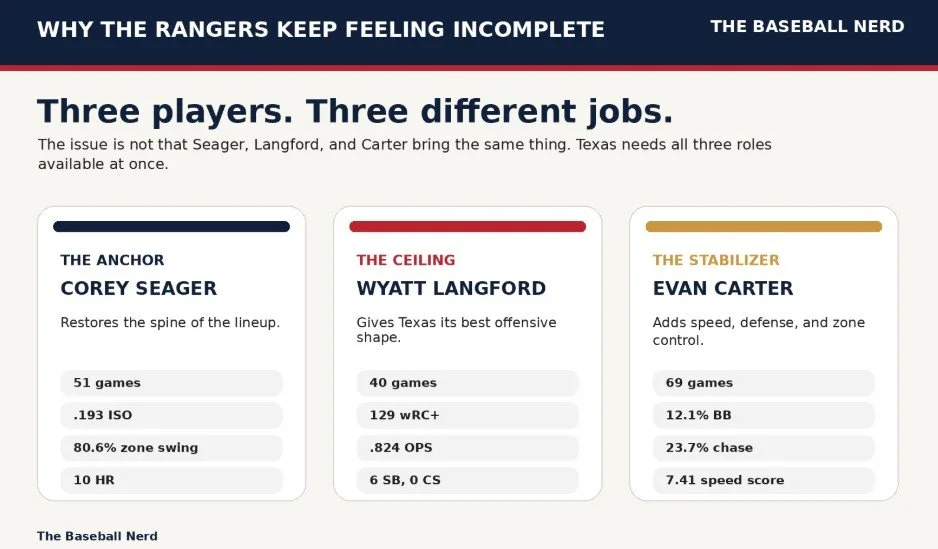
When he plays, he looks exactly like what the Rangers need. In 40 games and 173 plate appearances, Langford is hitting .278/.324/.500 with an .824 OPS, 8 home runs, 20 RBI, 6 steals, a .222 ISO, and a 129 wRC+. Among Rangers hitters with at least 150 plate appearances, he has been their most productive bat by wRC+.
That production is not empty. His contact rate is 80.0 percent. His swinging strike rate is 9.8 percent. His strikeout rate is 21.4 percent, which works for a hitter doing that much damage. He has also been perfect on the bases with 6 steals and 0 caught stealing.
Wyatt offers impact offense with enough contact, enough athleticism, and enough pressure to change the way the lineup feels. This should be one of the best stories of the Rangers’ season. Instead, it has become the most frustrating one.
Langford has played only 40 of 87 team games. That turns every great number into a question. A 129 wRC+ is a foundation if it lasts. In 40 games, it is slightly more than noise. But, Ranger fans have seen enough to know the bat can change the offense. The bat just has not had enough healthy weeks to know whether the body will let that happen over a full season.
Carter is the stabilizer, not the savior
Graphic by the Baseball Nerd
Carter belongs in a different lane. Langford is the offensive ceiling. Carter is the roster stabilizer.
In 69 games and 239 plate appearances, Carter is hitting .178/.289/.317 with a .606 OPS, 6 home runs, 21 RBI, 10 stolen bases, and a 75 wRC+. His offensive profile has been too light – Too many balls in the air, not enough authority, and not enough damage to make the low average feel like bad luck.
Carter still gives these Rangers the things the team needs. His walk rate is 12.1 percent. His chase rate is 23.7 percent, the best mark among Texas regulars. He has 10 steals without being caught, and his 7.41 speed score gives the Rangers an athletic element they do not get from most of the lineup. He can defend. He can run. He can control the zone. In a healthier lineup, that has real value. In a broken lineup, the lack of offense gets louder.
That is why his oblique injury mattered. While Carter is not the player who carries the lineup, he helps it make sense when the heavier bats are doing their jobs. The Rangers do not need Carter to be Langford. They need him available around Langford and Seager. Frustratingly, once Wyatt and Corey come back, Evan gets hurt. You can set your clocks by it.
The lineup has never gotten to become itself
The Rangers have played 87 games. Seager, Langford, and Carter have been available for the same lineup far less often than that number suggests. Texas has not simply lost three players for three separate stretches. It has lost the chance to let the offense settle around them.
The saving grace of this injury revolving-door is that Texas has gotten real help elsewhere. Josh Jung has hit .294/.357/.443 with a 126 wRC+. Joc Pederson has a 125 wRC+ with 14 home runs. Jake Burger has 14 home runs and 52 RBI. Brandon Nimmo has been above average at 112 wRC+ (but is also out with a shoulder injury while skipping the injured list for now). Justin Foscue has a 136 wRC+ in 102 plate appearances.
There are bats here, but support pieces can only solve so much when the top of the design keeps moving. Until Seager, Langford, and Carter overlap long enough to let everyone else settle into the right job, the Rangers are not really evaluating their offense. They will continue to evaluate their contingency plan.
The second half is about overlap
The Rangers are not broken, which is what makes this hard to write. They have enough talent to win games, enough bats to scare people, and enough pitching to stay in the division race.
Stability is the goal, and it seems a long way away.
Texas needs Seager’s back to stop deciding the offensive ceiling every few weeks. It needs Langford to turn impact into volume. It needs Carter to stay on the field long enough for his defense, speed, and strike zone control to fit around better bats.
The Rangers do not need perfect health, no team gets that, but they need enough overlap to become the version of themselves they keep promising us. The Rangers can win baseball games with this talent. Can the talent stay on the field together long enough for Texas to stop being a good idea and start being a dangerous team?