
The Athletics are a playoff team — for real this time
Last year, I dove deep on the newly-nomadic Athletics and the outlook for their 2025 campaign. I was my typically bullish self, particularly optimistic about their ability to get the most out of their unique blend of veteran and rookie talent, going so far as to declare them a guaranteed playoff team.
They, of course, were not.
Instead, they had the worst month of any team in the league in May, going 7-21 and plummeting in the standings. That hole proved too deep to dig out of, as the team went 54-50 from June onward and missed the playoffs by 11 games.
This season though, it appears there’s more reason for optimism about where this squad is heading. Young stars are continuing to flourish, and the front office is showing an early willingness to sign them to long-term extensions early. There’s money actually being spent on the team too; though they still rank among the league’s lowest payrolls, the A’s are spending $95M on talent this season, their highest single-season financial commitment since 2019.
With Opening Day less than 48 hours away, I wanted to revisit some of my takes about this team from last year, see if I was right or wrong, and try again to accurately project the near-term future of this franchise that I, for some reason, have such a strong affinity for.
Buckle up — there’s a lot to get into 🐘
Revisiting Last Season’s Predictions
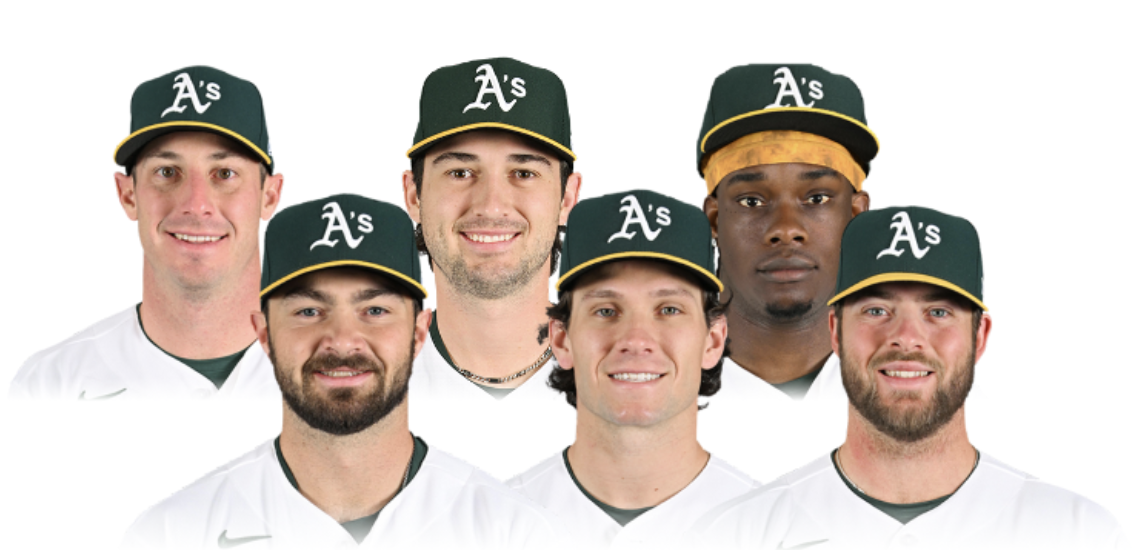
For those who didn’t read last year’s preview (which I assume is most of you), I made a series of predictions about several players I expected to make some significant noise in the 2025 season.
I didn’t cover Nick Kurtz last year, so I’ll briefly address him here before diving into the rest of the list: he’s a monster, and he’s only going to get better. The then-22-year-old rookie showed off prodigious power almost immediately, officially announcing himself to the league by launching four homers in a historic six-hit game last July. He finished the year with 36 dingers to his name, alongside a 1.002 OPS and a .290 average. Even considering his extremely high whiff and strikeout rates, he’s a clear offensive freak.
Kurtz’s peripherals are ridiculous: 93 mph average exit velocity (92nd percentile), 18% barrel rate (98th), 51.1% hard-hit rate (92nd), 22.2% chase rate (86th), 12.9% walk rate (90th)...his Baseball Savant page is a sea of red. Entering his age 23 season, there’s little doubt he’ll stake his claim as an annual SIlver Slugger lock at first base for years to come.
Now, with overdue acknowledgements accounted for, let’s see how clear my crystal ball was last winter:
Jacob Wilson, SS
2025 Stats: 125 G, 151 H, 13 HR, 26 2B, 5 SB, 62 R, 63 RBI, .800 OPS, 121 OPS+, 3.0 bWAR, All-Star selection
2025 Prediction: “If he can maintain a spray chart similar to what we saw in limited action last season, and build on the power skills, he should evolve into a balanced hitter that contributes regularly to an efficient offense.”
Was I right? — Yep!
Wilson was every bit of the player he was billed to be over a full season’s workload. He spread his contact around the field more, and his power potential (though limited) shone through as his slug jumped by nearly 150 points. His otherworldly contact ability and strike-zone awareness were on full display, underscored by his 9.6% whiff rate (99th percentile) and 7.5% K rate (100th). In terms of plate discipline and contact rate, no one in the league except Luis Arraez was better.
Wilson wasn’t the flashiest fielder, grading out slightly negatively on the defensive end, but he did more than enough to establish himself as a fixture of this franchise for years to come. The front office certainly felt as much: they inked Wilson to a seven-year, $70 million extension in January. If Wilson can keep effectively hitting to all fields while continuing to build up his power, he’ll be a perennial Silver Slugger candidate in no time. (And if he starts stealing bases consistently? Oh brother.)
Brent Rooker, DH
2025 Stats: 162 G, 154 H, 30 HR, 40 2B, 6 SB, 92 R, 89 RBI, .814 OPS, 123 OPS+, 2.3 bWAR, All-Star selection
2025 Prediction: “Brent Rooker will win back-to-back Silver Sluggers.”
Was I right? — No, unfortunately. Still a good season, though.
It was a down year in terms of overall slash and production for Rooker — which meant no Silver Slugger — but there were still plenty of encouraging signs. Rooker significantly reduced strikeout rate over increased plate appearances, logging a full 162 games played. He hit 40 doubles, fourth-most in MLB, and his 123 OPS+ was still a top-50 mark in MLB. Potential red flags from last season to watch for in 2026 are an elevated ground ball rate and decreased hard-hit rate, both of which definitely had a negative impact on his overall production. If he can keep the ball off the ground, Rooker should perform closer to his 2024 self…provided the spectre of his controversial Home Run Derby elimination isn’t hanging around to haunt him.
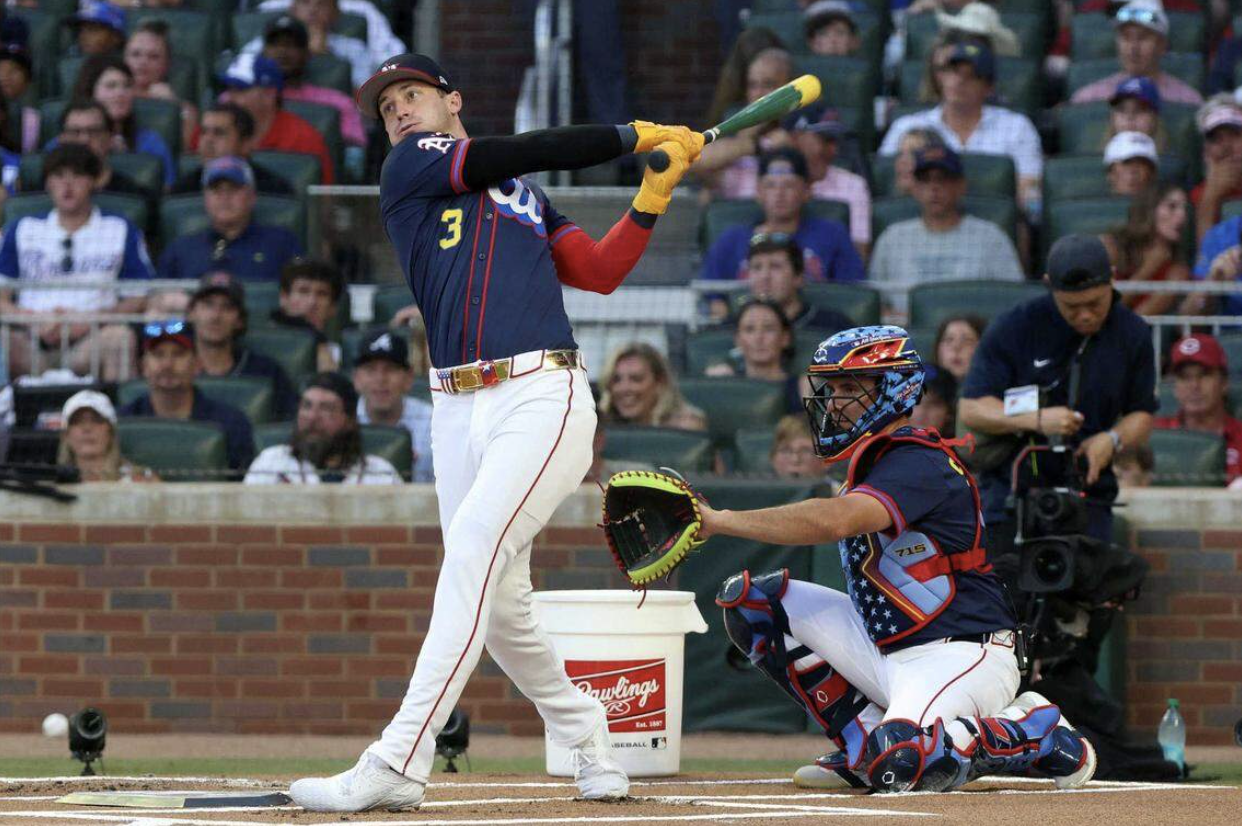
Rooker was eliminated from the 2025 Home Run Derby in a controversial tiebreaker decision. (© Jordan Godfree/Imagn Images)
Lawrence Butler, RF
2025 Stats: 152 G, 133 H, 21 HR, 22 SB, 83 R, 63 RBI, .710 OPS, 96 OPS+, 1.9 bWAR
2025 Prediction: “Lawrence Butler is a lock for a 20/20 season.”
Was I right? — Yes again!
Though Butler took a bit of a step back last season, the raw tools and talent potential remain through the roof, and were regularly on display, if not consistently. Butler remained an excellent defender, posting +4 Outs Above Average in the outfield. His deep hitting data also suggests that last season was potentially more blip than trend, as he still had barrel and hard-hit numbers. Butler’s bat speed is also electric, and he doesn’t chase a ton — if he can start hitting the sweet spot a bit more consistently again with a bit more pop behind the ball, he’ll be heading back in the right direction.
Shea Langeliers, C
2025 Result: 123 G, 133 H, 31 HR, 32 2B, 73 R, 72 RBI, .861 OPS, 134 OPS+, 3.9 bWAR
2025 Prediction: I didn’t make much of a prediction for Langeliers last year; I simply suggested that the existing tandem of him, Rooker, and Butler had already provided a better foundation for future success than the Matt Olson-Marcus Semien-Matt Chapman tandem had in years prior.
Was I right? — Spiritually, yes.
Langeliers casually cemented himself as one of the league’s best backstops last season, setting multiple career-highs at the plate despite playing in 14 fewer games than in 2024. His .849 OPS at catcher ranked fourth in all of MLB among players with at least 250 plate appearances at the position. Entering his age-28 season, Langeliers’s powers appear to be peaking right on schedule — he should be in for another big year in Sacramento, especially with a reportedly unseasonably warm summer on the horizon.
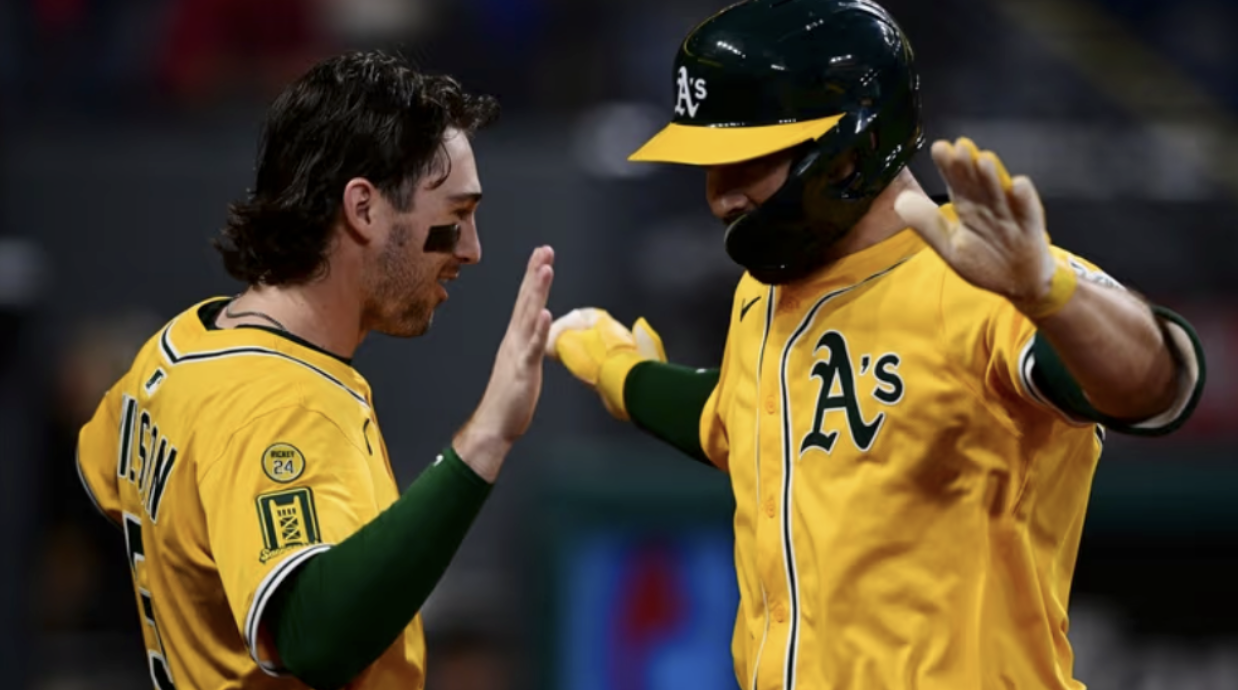
Jacob Wilson congratulating Shea Langeliers on one of his 31 homers. (© AP/David Dermer)
Colby Thomas, OF
2025 Stats: 49 G, 27 H, 6 HR, 5 2B, 2 SB, 20 R, 19 RBI, .684 OPS, 86 OPS+, 0.0 bWAR
2025 Prediction: “If he can get to an even league-average walk rate, bring the chase and whiff down, and learn how to start spreading the ball around the field, he’ll be an effective Major League piece in the not-too-distant future.”
Was I right? — TBD. I didn’t predict much for Thomas specifically in 2025, just that he’d be a big league contributor fairly soon. Neutral grade here.
Thomas was optioned to Triple-A on Sunday to start the 2026 season, a move that shouldn’t come as much of a surprise — the A’s just don’t have room in their outfield for him at the moment, and consistent plate appearances are essential to his continued development. Once he’s able to cut back on the strikeouts (37.1%), increase the walks (5.3%), and make more consistent hard contact in the zone, Thomas will be the first bat in line for a call-up should a utility need arise.
Mason Barnett, RHP
2025 Stats: 22.1 IP, 6.85 ERA, 4.88 FIP, 1.66 WHIP, 104 BF, 18 K, 7.3 K/9 (17.3 K%), 4.4 BB/9 (10.6 BB%), .286 BAA, 35.1 GB%, 43.2 Hard-Hit%, 62 ERA+
2025 Prediction: “Barnett will debut in a late summer middle-relief role.”
Was I right? — Sort of. Barnett was called up on August 26th, so I was right there, but he worked exclusively as a starter. Half points for me here.
Barnett’s final season line wasn’t anything to write home about, but there were some things going on beneath the surface that offer reason for hope. Manager Mark Kotsay often had encouraging things to say about Barnett after his starts last season, praising him for his ability to settle down under pressure and execute pitches at key moments while behind. Though not an ideal initiation to the Show, if Barnett can steady his location and refine his repertoire so he’s attacking the right parts of the zone with the right pitches, he’s absolutely got the raw stuff to stick around the major leagues. Whether that’s in a starting or long-relief role ultimately remains to be seen, but I’m not ready to give up on this guy just yet.
Prediction Success Rate: 3.5/6. Not bad!
Five Guys to Watch in 2026
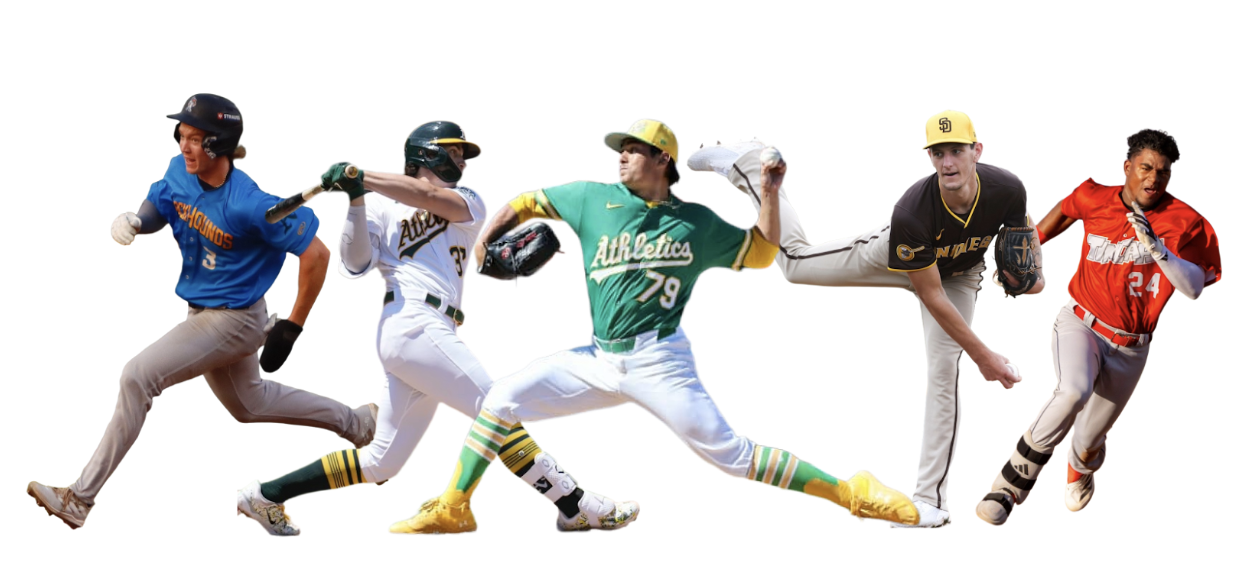
Now let’s take a look at some names that, while not all part of last year’s conversation, are sure to play a much bigger part in shaping this team’s identity for the rest of the decade.
Tyler Soderstrom, LF/1B
2025 Stats: 158 G, 155 H, 25 HR, 34 2B, 8 SB, 75 R, 93 RBI, .820 OPS, 126 OPS+, 4.3 bWAR
The latest young Athletic to receive a long-term deal, Soderstrom agreed to a seven-year contract extension worth $86 million. That’s the most money ever promised to a player by the franchise, and early signs suggest it’s money well spent. Soderstrom started the 2025 season off with an Opening Day homer and just kept raking, smacking nine homers alongside a .909 OPS through April. He cooled off a bit in May and June, but took the second half by storm, posting a 135 OPS+ over the final 61 games of the season.
With each season, Soderstrom has shown signs of improvement in key areas over larger and larger sample sizes — steadily reduced strikeout rate, higher BABIP, hitting the ball to all fields, improved line drive and hard-hit rates, etc. Provided his transition to the outfield continues going smoothly (he was a Gold Glove finalist in left field, finishing second in outfield assists with 11), Soderstrom will play a significant role in molding the immediate trajectory of this team.
Leo De Vries, SS
Scouting Grades: Hit: 60 | Power: 55 | Run: 55 | Arm: 55 | Field: 50 | Overall: 60
2025 Stats: 118 G, 116 H, 15 HR, 28 2B, 11 SB, 72 R, 74 RBI, .806 OPS
The fixture of last summer’s massive Mason Miller trade, De Vries started turning heads early. He’s a remarkably polished prospect for his age: at just 18, he hit .281 with a .910 OPS across 20 games at Double-A, fresh off a trade and entering a new organization. He walked at a 14% clip in High-A ball, and struck out less than 20% of the time at every level he touched last season.
All told, De Vries could very well be the Athletics’ long-term shortstop, as second base will likely suit Jacob Wilson’s skill set better over time. With Jeff McNeil only under contract through the end of this season and the now-19-year-old De Vries fresh off a strong spring (1.183 OPS, 3 HR, 20 hits, 19 total runs in 50 PA), there’s reason to believe the infield of the future isn’t all that far away.
Gage Jump, LHP
Scouting Grades: Fastball: 60 | Curveball: 55 | Slider: 55 | Changeup: 50 | Control: 55 | Overall: 55
2025 Stats: 112.2 IP, 3.28 ERA, 1.10 WHIP, 461 BF, 131 K, 10.5 K/9, 2.7 BB/9
When I first watched this guy pitch, my jaw dropped. Not only does he have an electric fastball (which averaged 96 mph this spring), but he pairs it with a looping curveball whose shape evokes memories of one Clayton Kershaw. He’s also got a nasty slider and changeup that work together to spread the zone in opposite directions while remaining incredibly difficult to tell apart out of his hand. It’s a deep bag of tricks, most of them plus-grade — no shock he’s the org’s top pitching prospect. Between Jump and upcoming phenom Jamie Arnold, the top pitching talent in last year’s draft, the Athletics have two of the top-ranked lefty prospects in all of baseball…and they’ll both be in the majors in no time.
Fresh off a debut professional season in which he pitched to a 3.28 ERA (2.96 FIP) over 112 innings across High-A and Double-A, Jump will start the 2026 season in Triple-A. If he keeps racking up strikeouts while keeping walks low and forcing a lot of ground balls (42% GB rate last season), he’ll be golden. Though there are lingering concerns about Jump’s size and how his stuff will ultimately age, he has all the makings of a surefire rotation-caliber talent right now. Based on the rate of his development, there’s a high likelihood he’ll see big league innings by summer.
Braden Nett, RHP
Scouting Grades: Fastball: 60 | Curveball: 50 | Slider: 55 | Changeup: 55 | Cutter: 50 | Control: 45 | Overall: 50
2025 Stats: 105.2 IP, 3.75 ERA, 1.47 WHIP, 468 BF, 116 K, 9.9 K/9, 4.1 BB/9
Braden Nett’s pathway to the big leagues has been anything but normal, and there’s nothing that endears me to a player more than a cool story. From dropping out of community college to working on a construction site to running out on a shift at Home Depot after getting the greatest phone call of his life, Nett offers as much by way of his personality as he does his stuff on the mound. He touched 99 mph with his fastball this spring, a pitch that sits comfortably above 94 mph on average and can be an elevated whiff machine when located correctly.
Nett’s pitch mix is deep, with a variety of shapes spread across a wide velocity range. Though walks have been an issue throughout his young career, he’s done well to cut it down significantly over the last two years, from a whopping 20% walk rate in 2023 to a more manageable 10% in 2025. If he can keep his strikeout rate steady while gaining control of the zone and his repertoire, Nett should make an impact on the big league staff in no time.
Henry Bolte, OF
Scouting Grades: Hit: 45 | Power: 55 | Run: 65 | Arm: 50 | Field: 50 | Overall: 50
2025 Stats: 114 G, 118 H, 9 HR, 20 2B, 44 SB, 66 R, 56 RBI, .812 OPS
I want this kid to be a successful big leaguer so badly. All the tools are there, and overall he made good on them last year. Between Double-A and Triple-A, Bolte smacked nine homers alongside 20 doubles, hitting .284 with an .812 OPS. He reportedly had surgery to address a nagging wrist issue that may have been responsible for some of the power loss he experienced last year, so look for the homer output to tick back up in 2026.
He also stole 44 bases last season, getting caught just twice. Scouts and team officials alike are very high on his speed tool both on the base paths and in the field, as it’s helped him develop into a capable fielder at all three positions. If he continues making improvements in the whiff and strikeout department (down from nearly 35% in 2024 to 29% in 2025) while also keeping his average 11-12% walk rate steady, Bolte should crack the lineup sooner than later, especially if Denzel Clarke’s bat doesn’t improve quickly.
Pitching Primer
Last year, I didn’t talk about the pitching staff, because I’d already rambled about team history and prospects for quite a while. This year, I’m going to ramble a little bit longer.
Though the pitching staff is really just one big question mark, I’m not quite convinced that means it’s a weakness. Though it’s a list devoid of flashy names, this group of arms in Sacramento could actually fare a bit better than they did last season. Luis Severino and Jeffrey Springs should be better at the top of the rotation now that they’ve had a year to adjust to Sutter Health, and if Sevy looks anything like he did in the WBC, I have a feeling he’ll perform closer to his 2024 self than not — especially if he wants to convince a contender to trade for him this summer.
I remain a Jeffrey Springs believer, and I feel the same about J.T. Ginn. With Springs, I can’t tell if my remaining faith is lingering purely because he’s a Rays product, or if it’s because he flashed such stellar potential before battling injuries in his final two years in Tampa. His average fastball velo sat at 90 mph last season, quite the drop from the 93 mph he averaged in his best year with the Rays. I’m still holding out hope that Springs can figure out how to rework his pitch mix to get more strikeouts with slower stuff, but he’ll also need to remember how to strand runners consistently while keeping the ball out of the air.
I’m familiar with Ginn from his brief time in the Mets’ farm system, where he was known as a high-upside arm who was good at limiting base runners and keeping balls on the ground. His repertoire features a zone-filling sinker and several breaking pitches with severe vertical drop. Though the quality of his stuff isn’t in question, his ability to execute it consistently is: against righties, he’s near-elite, but against lefties, he’s almost hopeless. If Ginn can learn how to better utilize his mix to get outs on both sides of the plate, he absolutely has the potential to be an effective big league pitcher, though something tells me the bullpen is likely where he’ll be most effective for the bulk of his career.
The addition of Aaron Civale could also prove beneficial beyond just the additional innings he’ll be asked to eat. In addition to a six-pitch arsenal that elicits mostly manageable contact, Civale brings veteran experience to an increasingly young clubhouse, always an important intangible to consider for a team in a transitional phase like this one. Civale battled a hamstring injury early last season, then bounced from the Brewers to the White Sox to the Cubs — I’d venture to guess some stability will help him reset and get his legs back under him.
We’ve seen Civale pitch decently-to-very well in bursts across recent seasons. In 2023, he posted a 2.43 ERA over 77 innings for the Guardians before he was traded to the Rays; the next season, he was traded to the Brewers in July, where he posted a 2.57 ERA over his final nine starts of the season. And with the Cubs last year, Civale posted a 2.08 ERA over 13 innings, his first ever out of the bullpen. There’s absolutely a solid backend starter in there somewhere, he just needs to execute.
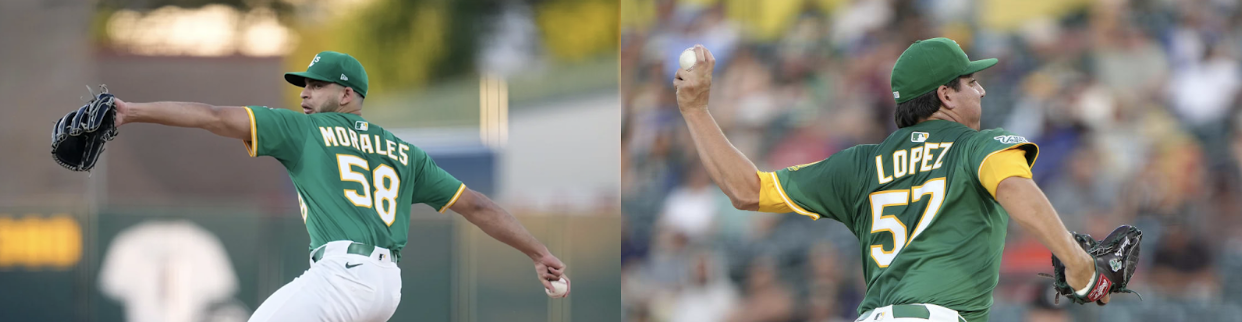
I’m also particularly excited about seeing a complete season from Jacob Lopez. Once he got rolling last year, the soft-tossing lefty showed off quite a bit of big league potential, perhaps best illustrated by a 10-strikeout gem against the Nationals in August. Despite an ERA over 4.00, Lopez offered lots to like, ending the year with a whopping 28.3% strikeout rate against a minuscule 3.8% walk rate. A flexor strain cut his season short, but provided he’s fully healthy entering Opening Day, Lopez should quickly become an anchor piece of this rotation.
I also can’t wait to see what Luis Morales looks like over a full season. Morales looked filthy in his limited MLB innings last year, touching 98 mph on his fastball and finishing with a 3.14 ERA over 48.2 innings. Though his walk rate has always hovered around that 9-10% range, he still stranded 85% of base runners, and his location data (107 Location+) plus the adoption of ABS at the big league level suggests to me that his strikeout rate should climb considerably with more innings. He needs to get better at missing barrels, too, but that should similarly come with experience and further refined pitch shapes (and maybe a cutter to work off his breaking stuff).
I’ll admit I’m probably a bit lower on the bullpen than some projections (which aren’t even all that high to begin with), but the additions of Mark Leiter, Jr. and Scott Barlow should at least help to stabilize the relief corps’ floor. In a recent interview with Athletics Nation, pitching coach Scott Emerson discussed the disastrous 2025 bullpen at length, stating that the focus for this season was to roll out a collection of multi-inning arms to operate behind the rotation; we’ll see if a combination of Ginn, Barnett, Leiter, and Barlow fit that mold.
(Do I still think they’d benefit from signing or trading for a proper closer depending on the standings this summer? Yes…but it’s a long season.)
A Key New Face
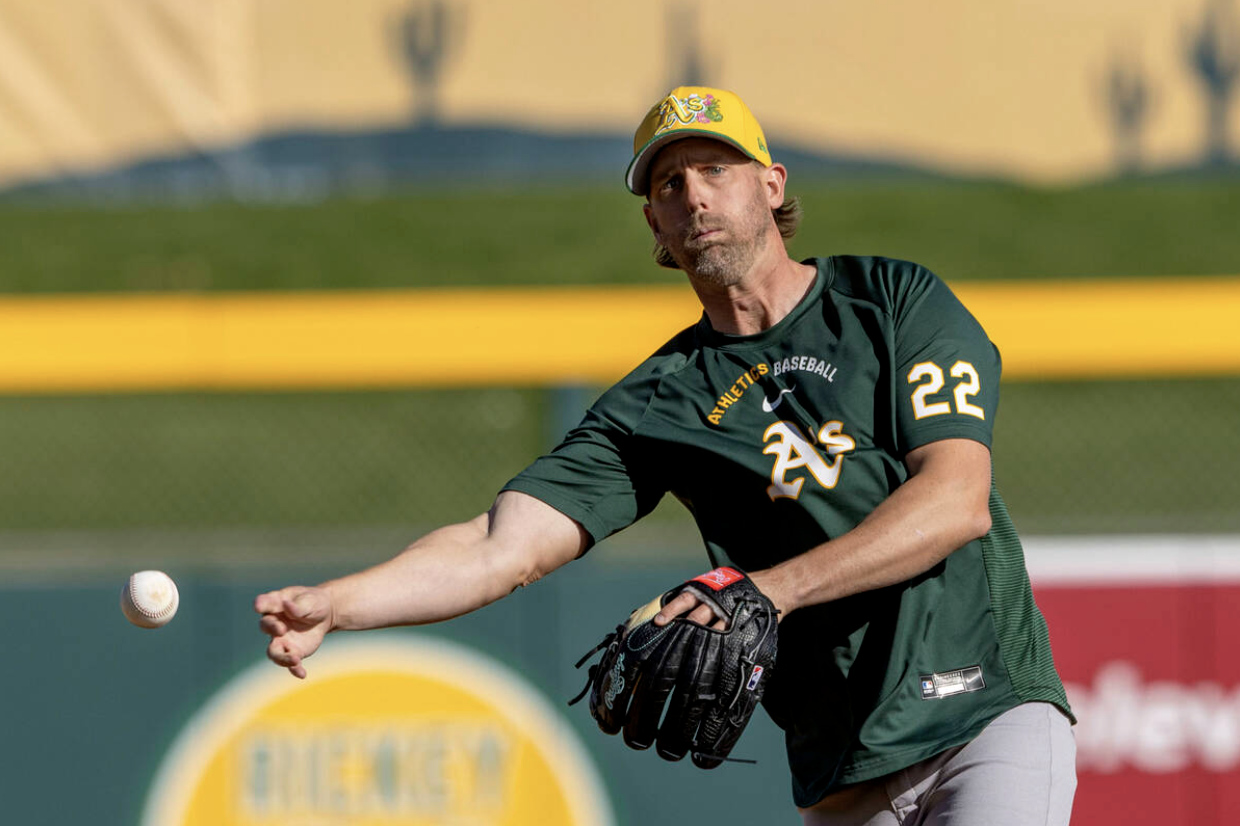
(© Heidi Fang/Las Vegas Review-Journal)
Jeff McNeil, 2B
2025 Stats: 122 G, 97 H, 12 HR, 21 2B, 3 SB, 42 R, 54 RBI, .746 OPS, 111 OPS+, 2.0 bWAR
Jeff McNeil’s final season with the Mets was a fine campaign, but it wasn’t strong enough to convince the team that he was going to be a key cog in their machine going ahead. His 111 OPS+ looks decent enough on paper, but within the context of his eight-year career, it was one of his four lowest marks, and it trails his next-best season by a notable 20 points. Still, he brings a level of plate discipline and old-school technical hitting that should complement Jacob Wilson very well.
I also anticipate moving to the much more hitter-friendly Sutter Health Park (108 Park Factor) should also help McNeil continue to unlock a bit more of the extra-base potential he’s always flashed. He also offers additional lineup flexibility, as he’s logged at least 360 plate appearances at nearly every spot in the batting order over the course of his career. While McNeil may not have been the gear that kept the Mets chugging, he may be exactly what these A’s need to kick their lineup into top gear.
Wrap Up & Predictions for 2026
If it wasn’t clear by now, I think this Athletics team is going to be much more competitive than projections and professional media believe. From a staff that’s maybe just one more year away from entering a new era of young stud arms to a lineup that’s literally teeming with talent waiting to break out, this Athletics squad has me tremendously excited.
I didn’t mention them above, but I also want to shout out the presence of Darell Hernaiz and Andy Ibañez on the bench. Both players graded out as plus-defenders last season, and they’re each particularly disciplined at the plate: neither hitter struck out above a 14% clip last season, and they both own a sub-20% whiff rate. Those are precisely the type of bats you want as backup. Between the veteran experience and positional flexibility of Ibañez and the youthful electricity of Hernaiz, they’re going to be a fun utility tandem to watch this season.
Between a balanced lineup, a rotation with lots of potential, and a loaded farm system, the 2026 Athletics should be a competitive baseball team that’s genuinely fun to watch. Though the franchise is in the midst of what seems to be an interminable rebuild, there’s reason to believe the light at the end of the tunnel is finally getting closer.
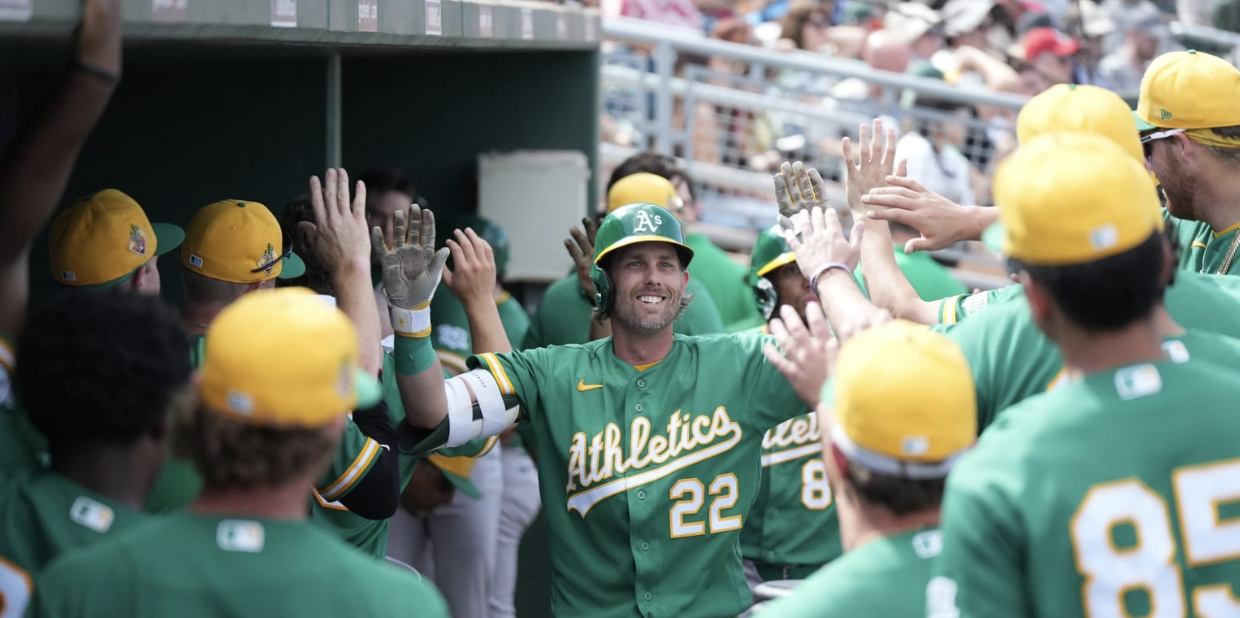
(© MLB)
Projections (ZiPS, PECOTA, etc.)
PECOTA Standings: 77-85 (4th in AL West)
Notable Hitter Projections (via RosterResource)
Jacob Wilson: 472 PA, 128 H, 12 HR, 22 2B, 5 SB, 57 R, 54 RBI, .836 OPS
Tyler Soderstrom: 533 PA, 125 H, 21 HR, 26 2B, 6 SB, 60 R, 72 RBI, .786 OPS
Brent Rooker: 611 PA, 144 H, 31 HR, 29 2B, 7 SB, 77 R, 86 RBI, .836 OPS
Lawrence Butler: 560 PA, 126 H, 22 HR, 27 2B, 17 SB, 73 R, 62 RBI, .752 OPS
Shea Langeliers: 515 PA, 114 H, 26 HR, 23 2B, 6 SB, 62 R, 70 RBI, .771 OPS
Jeff McNeil: 478 PA, 105 H, 11 HR, 21 2B, 6 SB, 52 R, 48 RBI, .711 OPS
Colby Thomas: 266 PA, 59 H, 10 HR, 11 2B, 5 SB, 36 R, 34 RBI, .735 OPS
Notable Pitcher Projections
Luis Severino: 159.0 IP, 9-9, 4.47 ERA, 1.31 WHIP, 134 K, 7.6 K/9, 3.0 BB/9
Jeffrey Springs: 147.0 IP, 9-9, 4.04 ERA, 1.25 WHIP, 128 K, 7.8 K/9, 3.0 BB/9
Aaron Civale: 124.0 IP, 6-8, 4.35 ERA, 1.27 WHIP, 112 K, 8.1 K/9, 3.4 BB/9
Jacob Lopez: 98.0 IP, 6-6, 4.13 ERA, 1.26 WHIP, 104 K, 9.6 K/9, 3.4 BB/9
Luis Morales: 81.0 IP, 5-5, 3.67 ERA, 1.21 WHIP, 77 K, 8.6 K/9, 3.2 BB/9
J.T. Ginn: 98.0 IP, 5-6, 4.50 ERA, 1.31 WHIP, 99 K, 9.1 K/9, 3.0 BB/9
Mason Barnett: 71.0 IP, 4-4, 2 SV, 4.56 ERA, 1.34 WHIP, 8.4 K/9, 3.4 BB/9
Mark Leiter, Jr: 55.0 IP, 4-5, 4.42 ERA, 2 SV, 1.35 WHIP, 60 K, 9.8 K/9, 3.3 BB/9
Scott Barlow: 65.0 IP, 4-4, 4.29 ERA, 3 SV, 1.35 WHIP, 68 K, 9.4 K/9, 4.6 BB/9
My Predictions
The offense will finish among the league’s top 10 units.
Luis Severino will be traded at the deadline, and Gage Jump will be promoted.
Brent Rooker will have his first 40 homer season.
The Athletics will make the playoffs in 2026.
Final Record: 81-81
Thanks for reading!
About the Author:
Drew Van Buskirk is a writer, baseball junkie, and diehard Mets fan currently based in Los Angeles. He launched Piazza Party in the 2024-25 offseason when he couldn’t find a more fitting way to channel his obsessive need to talk ball. Through a combination of player profiles, deep data dives, and walks down Mets memory lane, Drew strives to tell accessible, interesting stories that are equal parts entertaining and educational. He also provides weekly commentary for the Just Mets newsletter, where you can find him waxing poetic about the team every Wednesday and Sunday.