
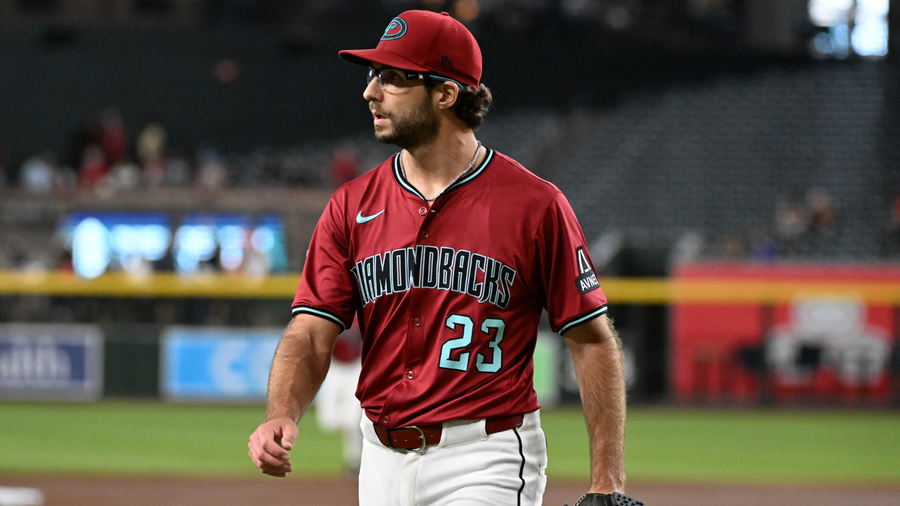
Zac Gallen of the Arizona Diamondbacks (CBS/Getty Images)
Through his age-27 season, the most similar pitcher in baseball history to Zac Gallen, according to Baseball Reference, was Yu Darvish. In 2023, Gallen finished third in NL Cy Young voting, made his first All-Star team, and started Game 1 of the World Series. The word “ace” was in the air.
Fast forward to when he landed on the IL this year with elbow inflammation, his 6.34 ERA and 1.561 WHIP were the worst of any pitcher in baseball with at least 98 innings, the Rockies excluded. He returned in September, made one start, and was moved to the bullpen for the first time in his eight-year career.
It may have seemed as though Gallen plummeted, but he’s been falling with style for years and nobody noticed until his ERA started with a five. To find out how it happened, I went through his arsenal pitch by pitch, and some of what I found is genuinely bizarre. Let’s start with the pitch that’s thrown more than any other.
Four-Seam Fastball (35.2% in 2026)
For a brief definition and explanation of “run value”, click here.
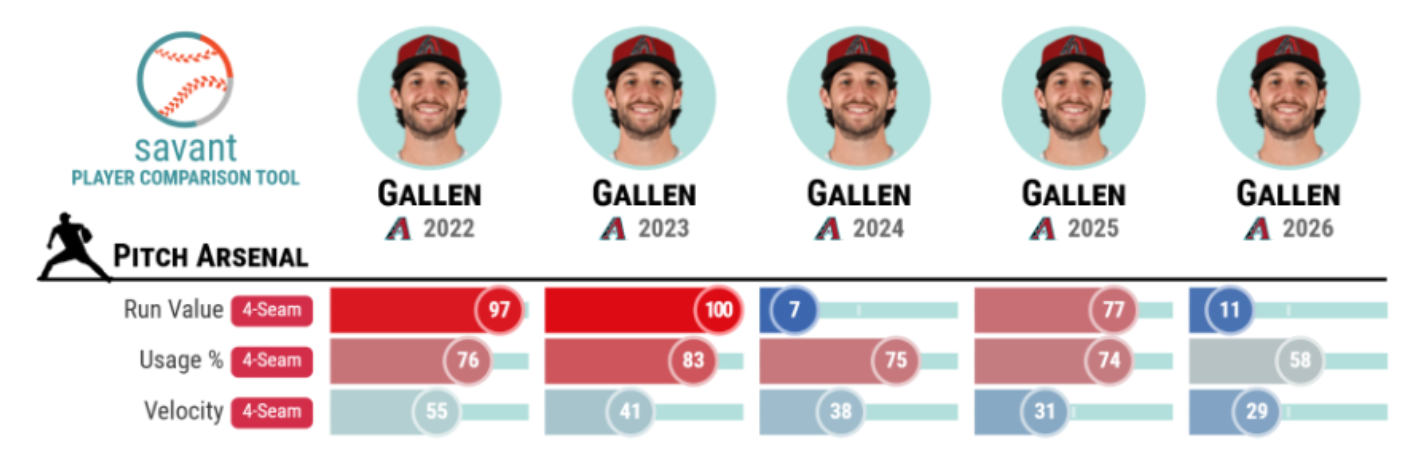
In 2023, Zac Gallen’s four-seam fastball ranked in the 100th percentile in run value (+26 runs). It was the most valuable fastball in baseball, outside of Gerrit Cole. A year later, it ranked in the 7th (-7 runs). This pitch has been a rollercoaster. After the collapse in 2024 (-7) came a recovery in 2025 (+4), and then another collapse (-6 runs in 2026). Few pitches in the league have experienced such erratic highs and lows, but what makes it strange is that the measurables haven’t necessarily fallen off.
While the velocity has remained consistent, in the 93-94 MPH range, the league has sped past him. His velocity percentile has slid every year, from 55th in 2022 to 29th in 2026. His usage has followed it down, from the 83rd percentile in 2023 to the 58th now. Gallen is throwing fewer heaters than ever, and since 2023 the effectiveness has been an annual coin flip.
Knuckle-Curve (19.1% in 2026)
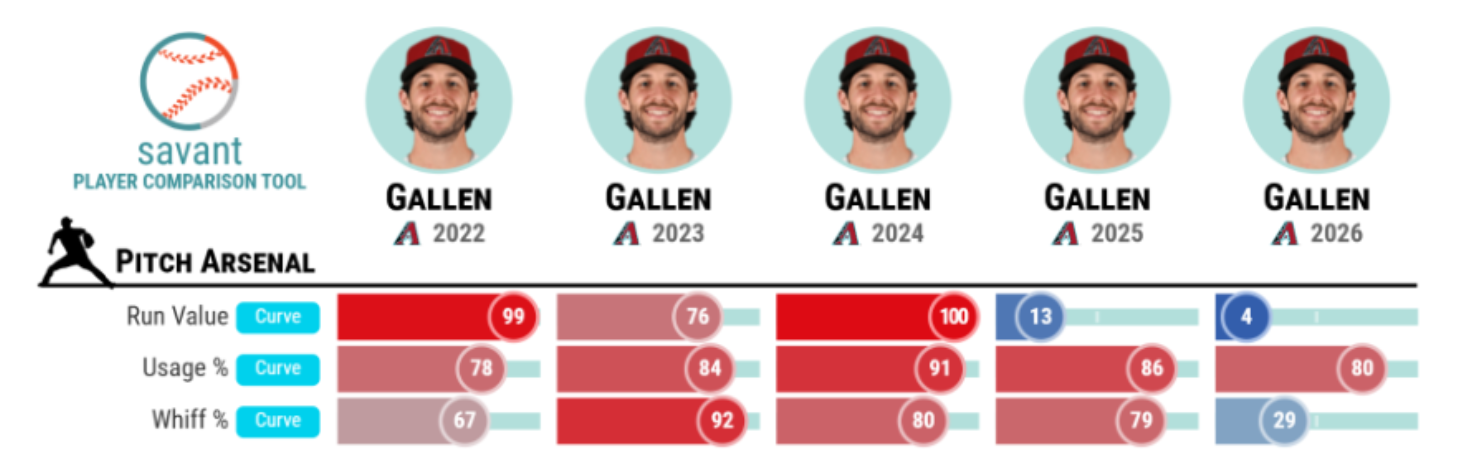
In 2024, the year his fastball fell to the 7th percentile, Gallen’s curveball ranked in the 100th, the best in baseball by run value (+15). That is the pattern with these two pitches: when one prospered, the other floundered. The curve carried him in 2024 while the fastball cratered. In 2025 they traded places, with the fastball back at the 77th percentile and the curve down at the 13th.
Between 2023-2025, the knuckle-curve led his arsenal in both whiff rate and put away percentage (the rate of two-strike pitches that result in a strikeout). It could keep batters off balance while he attacked with his fastball; this year, the bottom dropped out for both pitches. Batters hit .360 against the knuckle-curve while slugging .587, with a career low in both whiff rate (-15.5% drop) and put away percentage (-18.7% drop). The swing and miss stuff just wasn’t there anymore, and its run value sank to -7 runs, another career low. The curve also experienced a 4.4% drop in usage, becoming third fiddle to the next pitch.
Slider (23% in 2026)
We are now entering bizarre territory. Zac Gallen’s slider has never been a good pitch. In seasons where he’s thrown over 100 sliders, he’s never had a season with a batting average below .290. He’s also never had a season where it finished with a run value above zero (his highest mark was -1 in 2022, min.100 pitches). The pitch has only gotten less effective as time has gone on. In 2025, it seemingly hit bottom. Gallen’s slider ranked in the 1st percentile in run value, accruing -7 runs. It was quite literally the least valuable slider of any qualified pitcher in the league.
So in 2026, he returned to the Diamondbacks and threw it twice as often. The usage rate jumped from 13% to 23%, and guess what? It was still bad! When he was placed on the IL in July, he once again had the worst slider in the league by run value. I do not understand why or who thought it would be a good idea for Gallen to increase his slider usage after the disaster that was 2025, and I hope he can learn a lesson from the repeat results.

Changeup (17.1% in 2026)
This section is a bit of a palette cleanser; this is the one pitch that still works and has never wavered. The changeup’s run value has never dropped lower than the 85th percentile, and it continues to be effective against batters on both sides of the plate. Ranking fourth in Gallen’s 2026 usage, this pitch by far led his arsenal in opposing batting average and slugging % (.141 and .183); in fact it’s the only pitch with an opposing slugging % under .500. Through all of his struggles, he’s never lost the feel for his change.
Conclusion
The number 23 seemed like it was destined to hang in the rafters at Chase Field next to 51, 20, and 42; today we know that’s not going to happen, but Gallen’s already in the top five of all the franchise’s counting stats for pitchers. At the very least, it seemed that he was going to earn a big payday elsewhere. As of fall of 2026, his future is incredibly uncertain, but I am ever hopeful that he can get a fresh start on a major league roster, and I am ever grateful for the contributions he made to my team.