
Rookies In Review: Japanese Edition
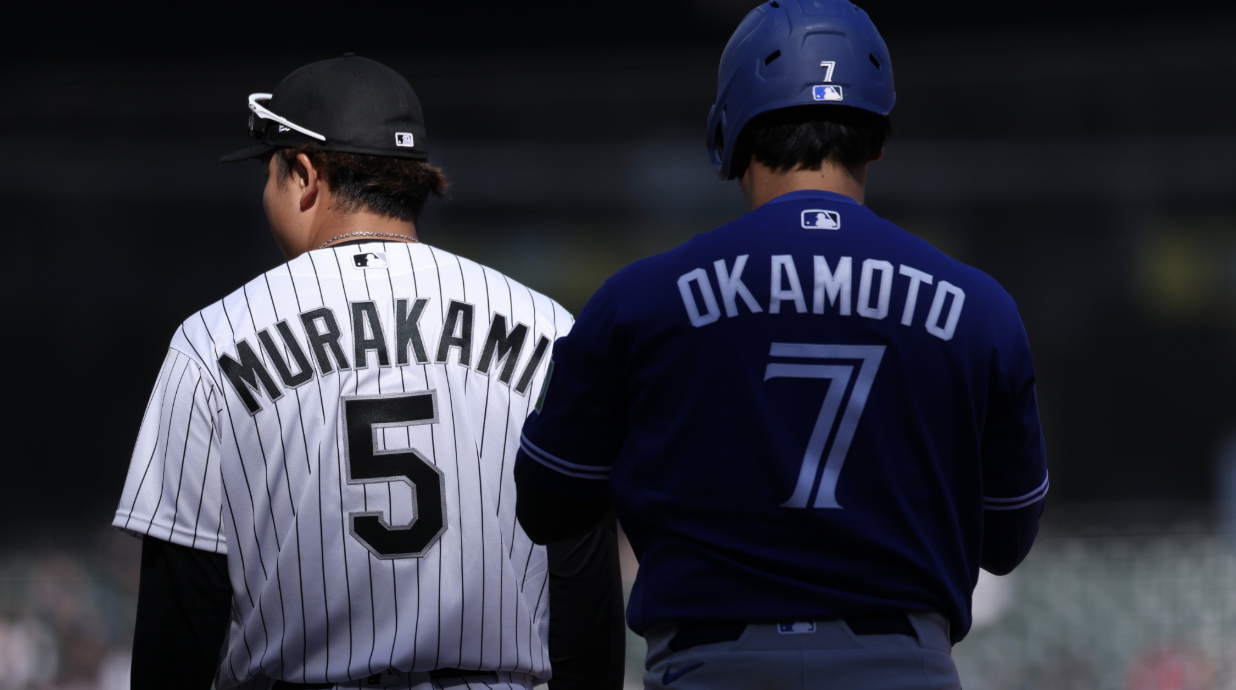
Photo from @MLB Twitter/X
Every offseason, there is at least one player who is looking to make the jump from Japan to the Majors. Throughout the years notable names like Hideo Nomo, Ichiro Suzuki, Hideki Matsui, Yu Darvish, Masahiro Tanaka, Shohei Ohtani, Yoshinobu Yamamoto, or Roki Sasaki have challenged themselves by coming over to North America.
There are many ways in which a player from Japan can come over to the Majors. If a player has served no more than nine years of service with their NPB team, they must go through the posting system. However, unless the player is at least 25 years old and has played six professional seasons, they are subjected to international bonus pool money (ie. Ohtani, Sasaki). If the player has served nine or more years of service, then they are able to declare for international free agency and do not need to be posted.
In 2026, there were three players who made the jump: Munetaka Murakami, Kazuma Okamoto, and Tatsuya Imai.Each player had high levels of success during their NPB careers and decided to come over to MLB this season. How did each player do?
Munetaka Murakami
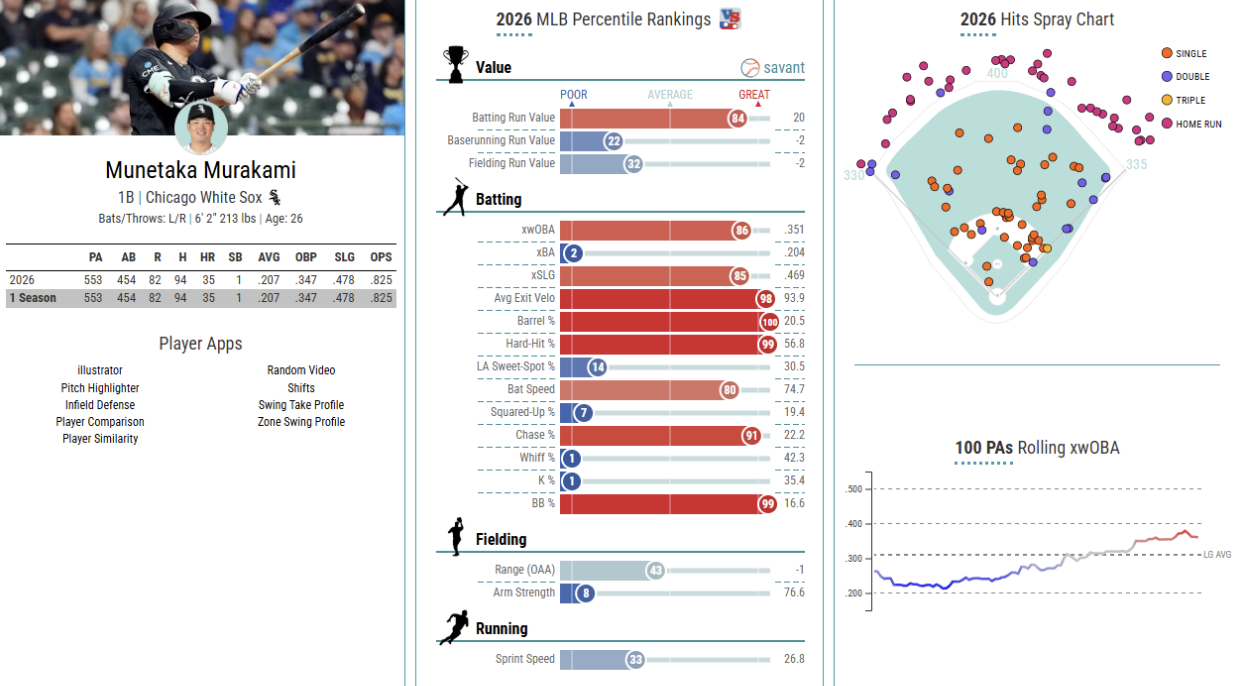
Munetaka Murakami Profile (Baseball Savant)
The Tokyo Swallow 3B dominated the NPB for eight seasons. In his eight seasons, he hit .270/.394/.557 with 246 home runs, 647 RBI, and 33 stolen bases. He had a very decorated career in Japan. He was a two-time Central League MVP, four-time All-Star, 2019 Central League Rookie of the Year, and 2021 Japan Series champion. His best season came in 2022 where he won the Triple Crown and hit .315/.458/.710 with 56 home runs, 134 RBI, and a 225 wRC+.
During the 2026 offseason, Murakami signed a 2-year, $34M contract with the Chicago White Sox. In his first season in the Majors, Murakami hit .207/.347/.478 with 35 home runs, 77 RBI, and a 129 wRC+. After a blistering first half in which he was named an American League All-Star, Murakami slowed down significantly in the second half.
Mune does several things well. He possesses plus bat speed, elite batted ball metrics, contact quality, does not chase outside of the zone, and draws a lot of walks. His 35 home runs ranked 10th in the Majors (tied with Brandon Lowe), and first amongst rookies in 2026.
Murakami’s biggest issue has been the swing and miss. During his NPB career, he had a strikeout rate of 25.8% whereas in his first MLB season, his strikeout rate ballooned to 35.4%. Those issues were exacerbated during the postseason where he had a 51.6% strikeout rate in 31 plate appearances.
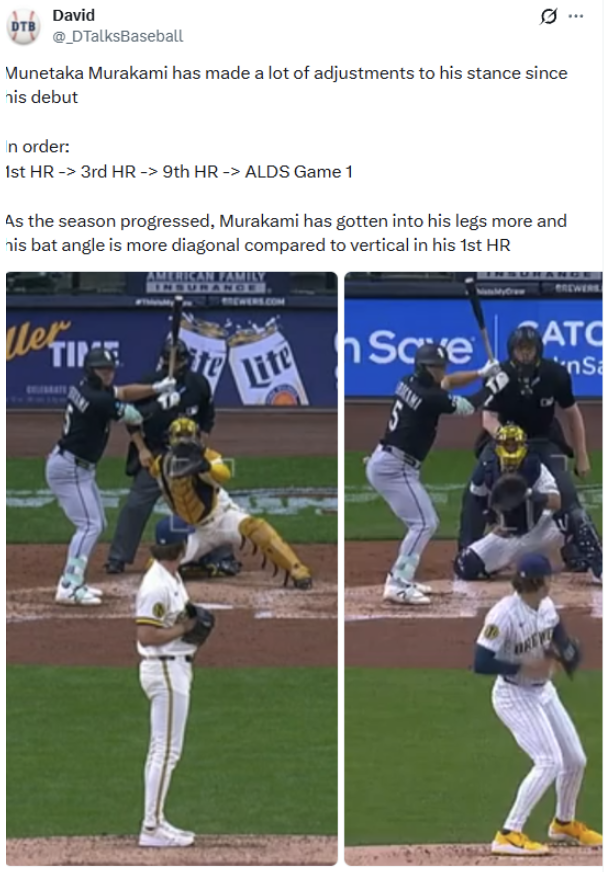
In order to avoid slumps like he experienced in the second half, he will need to cut down the strikeout rate. He did make adjustments throughout the season which bodes well for his willingness to make changes. Murakami is an unrestricted free agent after the 2027 season meaning it could be an already make-or-break year for him next season.
Overall, despite the slow second half, Murakami’s first season in the Majors would be a success.
Grade: B
Kazuma Okamoto
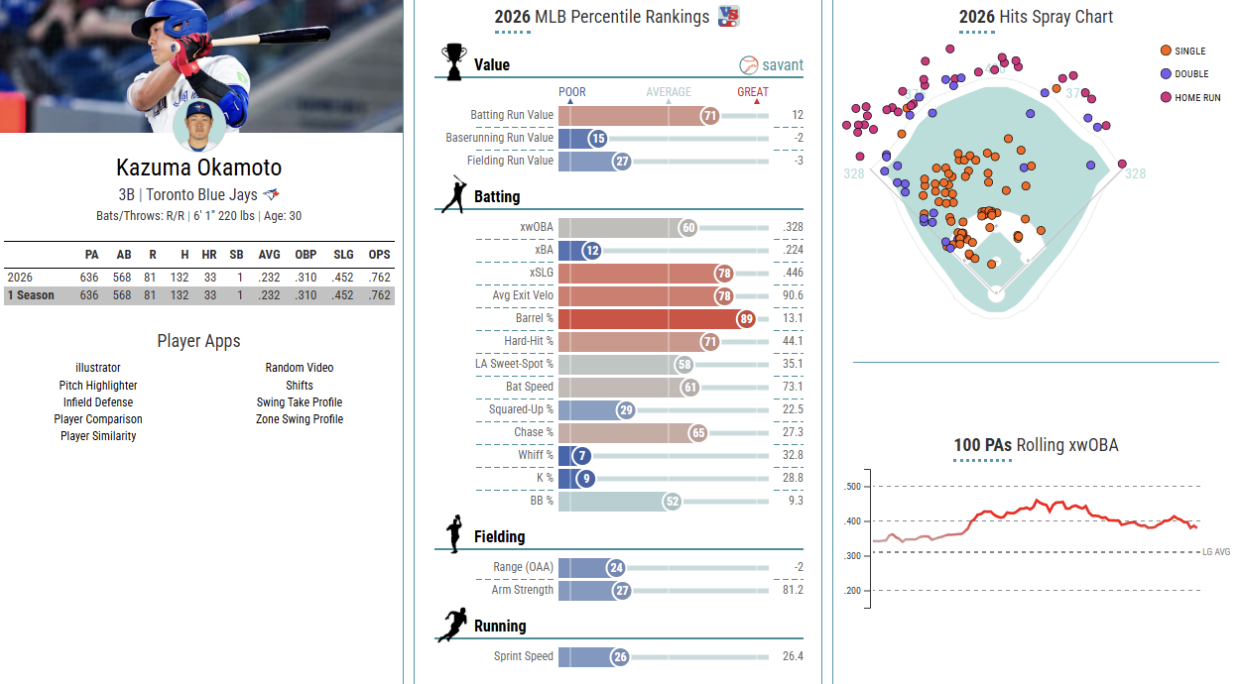
Kazuma Okamoto Profile (Baseball Savant)
Okamoto spent 11 seasons in the NPB and was dominant throughout. For his NPB career, he hit .277/.361/.521 with 248 home runs, 717 RBI, and 13 stolen bases. Much like Murakami, Okamoto had a very decorated career in the NPB as well. Okamoto was a six-time All-Star, three-time home run leader, two time RBI leader, and three-time Mitsui Golden Glove winner.
The third baseman signed a 4-year, $60M contract with the Blue Jays during the 2026 offseason. In his first season with the Blue Jays, Okamoto hit .232/.310/.452 with a 113 wRC+. He broke the single-season franchise record for most home runs hit by a rookie with 33. Those 33 home runs also ranked 11th in the Majors (tied with Miguel Vargas and CJ Abrams).
While Murakami had polarizing first and second halves, Okamoto had his stretches of running hot and cold. After a decent first couple of months, Okamoto got hot in June. However, in the following two months, he would struggle before getting hot again in September.
Kazuma had above-average bat speed and batted ball metrics, but excelled with his contact quality as evidenced by his 89th percentile barrel rate. Okamoto’s 26.8% pull-air rate was elite as it ranked in the
In Japan, Okamoto was not known for his strikeouts as his career strikeout rate was 17.7%. Surprisingly, swing and miss would be one of his biggest issues in the Majors as it jumped to 28.8%. After having a strikeout rate of 30.9% in the first half, it dropped to 25.6% in the second half which bodes well for his future success.
Overall, there is enough reason to be optimistic with Okamoto as evidenced by his second half gains. Controllable for three more seasons, Okamoto should remain a productive fixture in the middle of the Blue Jays lineup.
Grade: B-
Tatsuya Imai
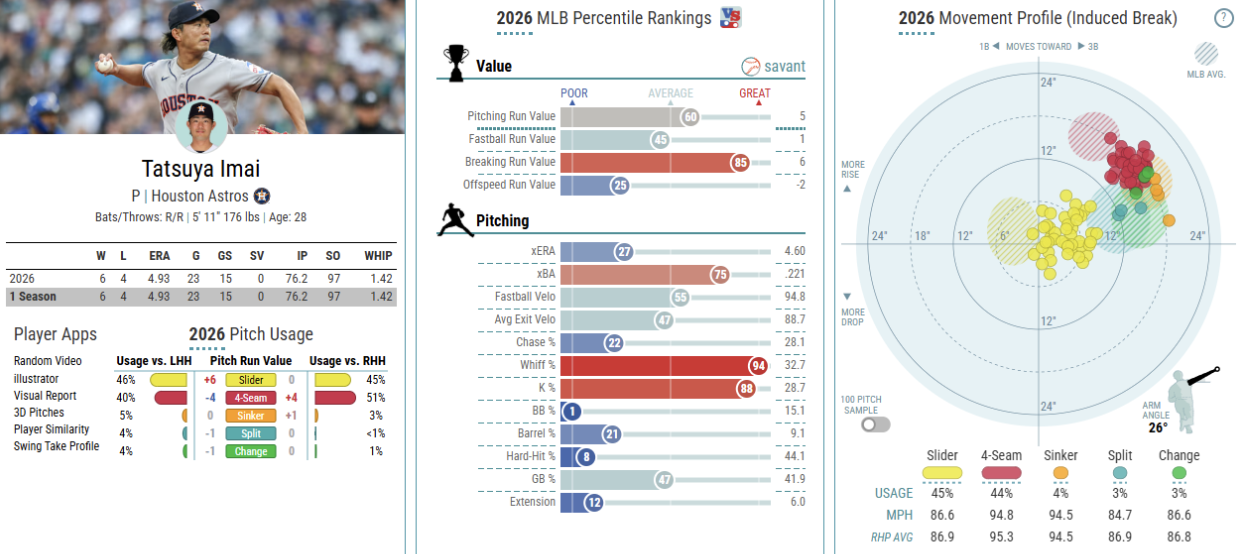
Tatsuya Imai Profile (Baseball Savant)
Imai was the only pitcher from the NPB to make the jump to MLB. In his eight seasons in the NPB, Imai posted a 3.15 ERA with a 1.27 WHIP over 963.2 innings and 907 strikeouts. Imai did not have as decorated a career as Murakami or Okamoto, but he was a three-time All-Star himself.
In the offseason, Imai signed a 3-year, $54M contract with the Houston Astros. He would go on to have a shaky first season as he posted a 4.93 ERA and 1.42 WHIP over 76.2 innings with 97 strikeouts. Injuries and struggles with command hurt Imai in his first season. Imai was a starter to begin the season but eventually found himself in the bullpen by early August.
The righty showed flashes of brilliance. In his second start, he threw 5.2 scoreless innings while striking out nine Athletics. He would have a two-start stretch in June against the Guardians and Tigers where he threw 12 scoreless innings and struck out 21 batters.
The former Seibu Lion showed an elite ability to generate swing and miss. His 28.7% strikeout rate ranked 24th amongst pitchers with at least 70 innings pitched.
In his final two seasons in Japan, Imai was able to bring down his walk rate to less than 10% each season after being at least 10.7% in each of his first six. That walk rate jumped to 15.1% in the Majors as he was adjusting to the Major League ball.
Imai does have an $18.7M opt-out at the end of the season, and it would be a major surprise if he took it given how much he struggled. His command will need to improve if he wants to remain a starter long term. If he can not, he has the makings of a solid setup man.
Overall, the potential is there for Imai, it all comes down to his command. Controllable for two more seasons, Imai has the chance to be a solid mid-rotation starter.
Grade: C+
About Me
My name is David and I am a Blue Jays fan. I love all things baseball whether it is the sport itself, how data helps the sport, or prospect talk.
Follow me here:
Twitter: https://x.com/_DTalksBaseball
Substack: https://substack.com/@davidtalksbaseball