
Sophomore Cam Schlittler for the Cy?

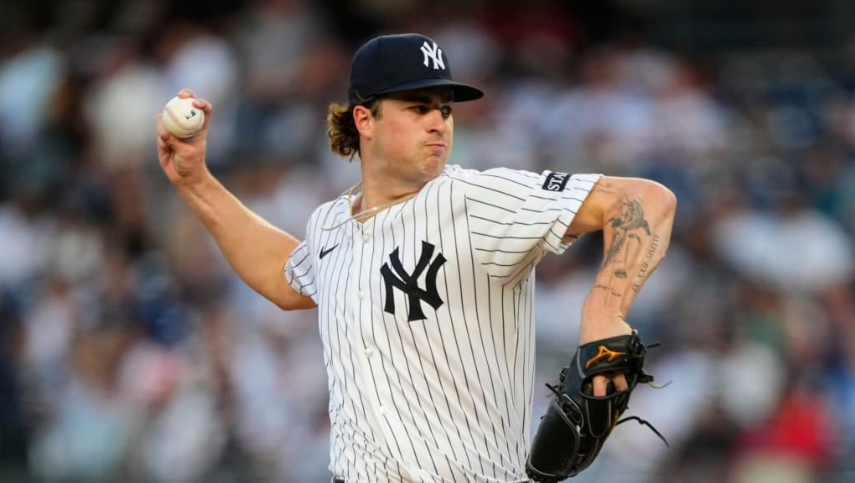
Cam Schlittler of the New York Yankees (Photo by Julio Aguilar for Getty Images)
Cam Schlittler is an analytical monster. Originally a seventh-round flyer for the Yankees, Cam has ascended into the clear ace for the Bronx Bombers. He’s leading the AL in WAR, WHIP, ERA, and narrowly trails Dylan Cease in strikeouts.
Cam may be on his way to the pitching Triple Crown in his sophomore season. He’s 9-5 with a 2.05 ERA and 137 Ks through 118.2 innings, all while throwing non-fastballs less than 10% of the time. No fancy slider, no nasty changeup, just diesel.
It didn’t start this way. Cam tossed three successful seasons at Northeastern University and was a strong strike-thrower, but his fastball was only around 90-92 mph in college. Hissecondary mix was real but shaky at best. The Yankees decided he was worth a draft pick in 2022, but Cam has shown he’s much more than that.
A testament to both the Yankees’ pipeline and his own work, Cam went from averaging 90 mph at a 32.4-degree arm angle to 96.9 at a 41.4-degree slot over two years. He also added a cutter, which now serves as one of his best offerings in the “Bermuda Triangle.” Below is his minor league mix in 2023, compared with A-ball averages.
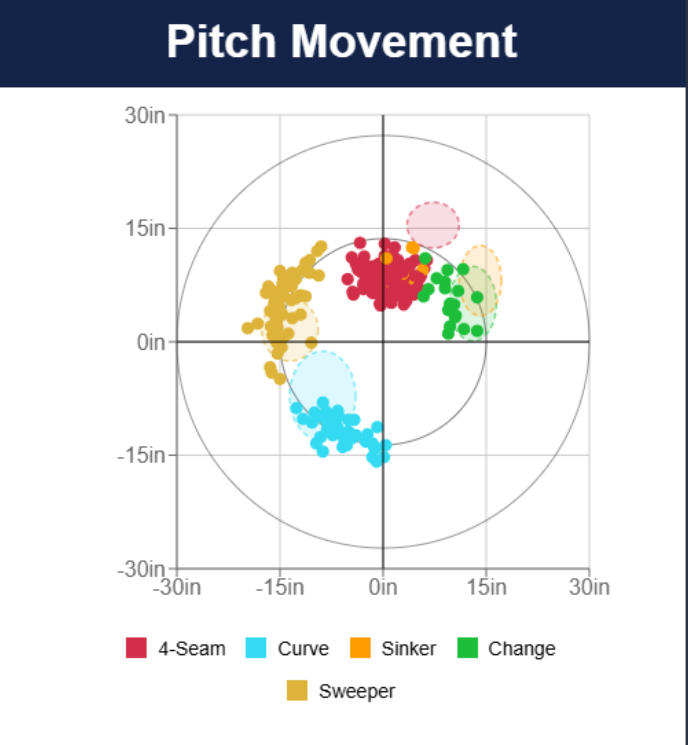
Cam Schlittler’s Prospect Savant in 2023
He got the call in 2025 and proved the hype was real by pitching to a 2.96 ERA with 84 punches in 73 innings. The only issue was the walks. He issued a free pass to 10% of batters, ballooning his xERA to 4.10. Cam looked like a flamethrowing starter with an incomplete arsenal and some control issues—not a breakout Cy Young candidate.
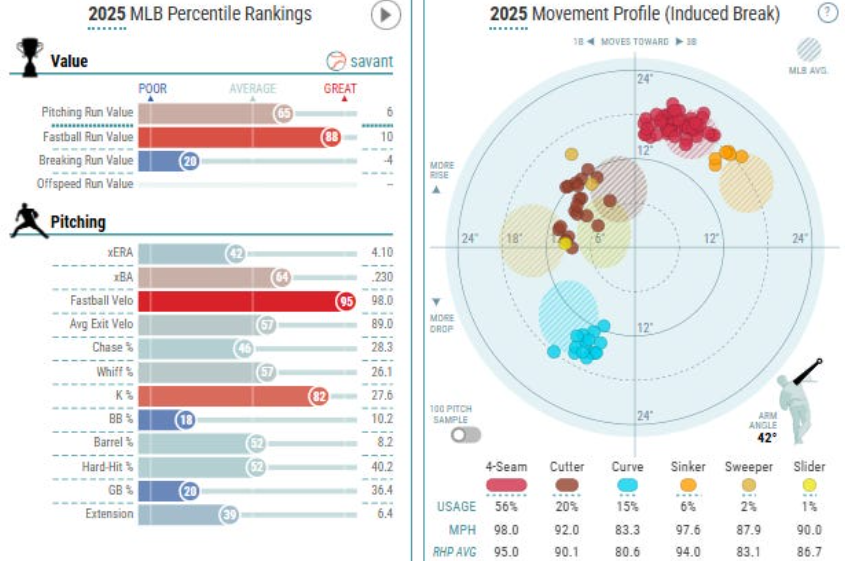
Cam Schlittler’s Baseball Savant in 2025
Cam ramped up his sinker usage and tightened his cutter in the offseason to bring us the 6’6” right-hander we know today.
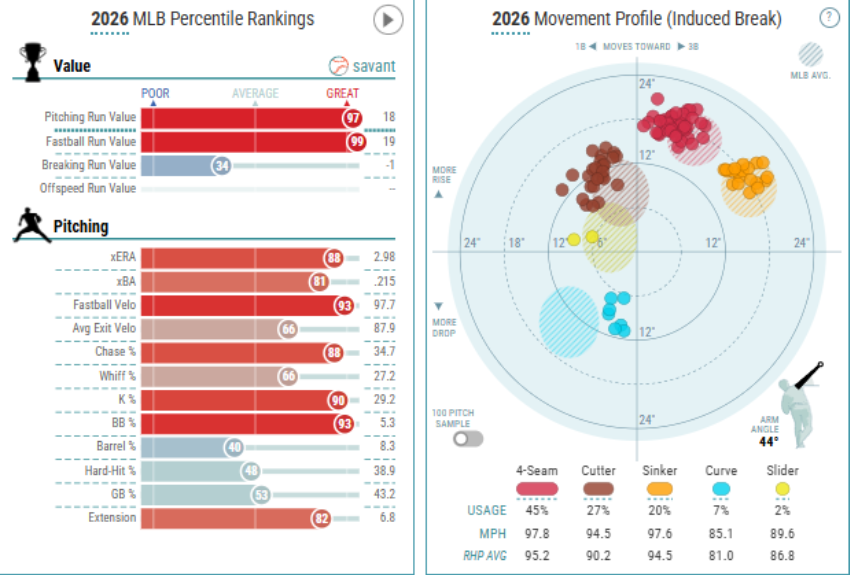
Cam Schlittler’s Baseball Savant in 2026
He throws fastball variations roughly 92% of the time. Hitters can effectively gear up for the heat every single pitch and still go down swinging. I found a couple of main reasons:
Reason I: The Diesel, Propane, and Biofuel
By these, I mean fastballs, alternatively known as ‘gas’. Cheesy nicknames aside, Cam Schlittler’s bag isdeep when it comes to heaters. He throws four-seams, sinkers, and cutters. (Feel free to decide which one is propane, I can’t.)
Every single one posts above-average velocity and movement. Simply, they are hard to hit even if you know they’re coming.
League-wide results in 3-0 / 3-1 counts paint a clear picture of how hard it is tohit a strong fastball. There have been 14,148 examples of a near-guaranteed heater, but only 718 of these situations directly resulted in a hit.
In other words, batters are highly likely to see this pitch family. They know (almost) exactly what’s coming, but have a 5% chance of doing inning-extending damage.
Fastball variations account for 20.9% of all pitches thrown this year, and the xBA on those, you ask? .241.
That makes sense; slightly above average velocity is correlated with a slightly below average xBA.
However, against four-seams with Cam’s velocity numbers, the average crashes to .207. Velocity aside though, Schlittler’s dominance has been seen as a bit of an enigma due to a league-wide trend ofthrowing fewer fastballs, not more.
We could call the Cy Young favorite an outlier and move on, but that’s nowhere near the full picture. It’s true that four-seam usage has been declining over the years. We’ve gone from 36.1% league-wide usage in 2016 to 30.4% usage so far this year. The four-seam fastball is becoming increasingly scarce, but not because every pitcher throws sweepers and splitters now.
Rather, cutters and two-seam fastballs are making up a portion of the difference. They’ve been slowly on the up, going from 22.4% usage in 2021 to 24.4% usage in 2026 as the “multiple fastballs” approach has become a major developmental strategy. If pitchers have a variety of moving fastballs, they’ll be able to prevent hard contact when they fall behind in the count. A cutter that moves just a few inches glove side instead of a predictable four-seam makes hard contact much moredifficult. Cam Schlittler has taken this to the extreme which explains his dominance beyond the radar gun.
Reason II: Using heaters as breaking balls
Throwing a two-seam instead of a four-seam when you have both isn’t just a random selection. Fastballs are sequenced just like other weapons. By burning a heater up and away, Cam easily sets up a cutter in on the hands. That’s exactly how Schlittler keeps hitters off-balance without massive breaking pitches.
It helps that his cutter effectively behaves like a breaker. It’s got 10.5 inches of rise with 5.7 inches of glove-side “dart.” Those numbers put the Cam Schlittler cutter firmly in outlier territory, and quickly drew comparison to Corbin Burnes in 2021, when he spammed his cut-fastball 52% ofthe time and won the NL Cy Young doing it. He used his cutter as a means of separating from his sinker and changeup, and to create a downward curveball tunnel. These were his numbers:
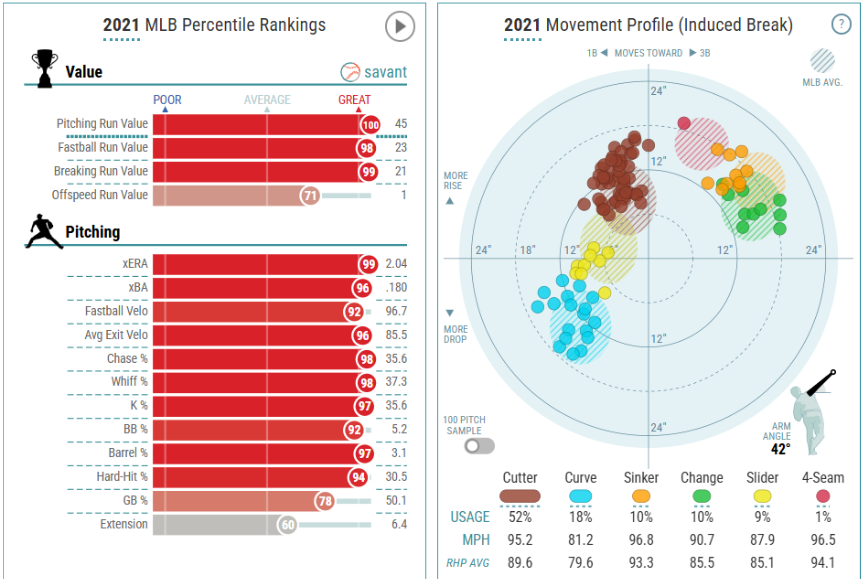
Corbin Burnes Baseball Savant
It’s fair to question how Cam dominates with so many fastballs. Part of the answer is because we classify all cutters as fastballs. So while Cam’s cutter qualifies as a fastball, it behaves as more of a breaker sequencing-wise, and his sinkers and four-seams help set it up.
Additionally, the upside for throwing so many fastballs is that they are the easiest pitches to command. It’s unlikely there’s a day where we see Cam have absolutely no feel for one of his three gas pedals, but an off day can turn great sliders into soft spinners and sharp curveballs into flat hangers. Cam isn’t nearly as vulnerable to that. He just grips the fastball variation and burns it as hard as he can into the zone.
Oh right, he’s also got more margin for error in his delivery because fastballs aren’t such aggressive movers. A mislocation on a slider could have it up in the zone, way below, or straight down the middle. The risk for a sinker? It’s off targetbut still over 95 mph in Schlittler’s case.
Naturally, if this were the best way to pitch, everyone would do it. Throwing this many heaters is only something the likes of high-velocity arms should attempt. One would also need a great feel for creating strong break separation and tunneling for these variations.
Bonus: Tunneling
MLB.com
I created a Python script based on some publicly available release-point data. Cam Schlittler holds an extension difference near zero between his fastball variations, meaning his travel down the mound tells hitters nothing about which pitch is coming. Cam sits near the top of the leaderboard on his sinker with a high-variation score concerning four-seam separation. That’s all statistical jargon meaning Cam is effective at tunneling his heater variants according to the model. It’s a rudimentary analysis of tunneling, but the script managed to point out strong metrics for Ryan Helsley’s slider in 2025 and Nick Martinez’s changeup, both of which have excellent run value statistics.
About the Author
This post was produced by Ransom Fassett for Painting Corners. You can find more strong analysis and underrated pitchinghere.