
Hypothesis Interrupted: The Rays' Unfinished Pitching Experiment
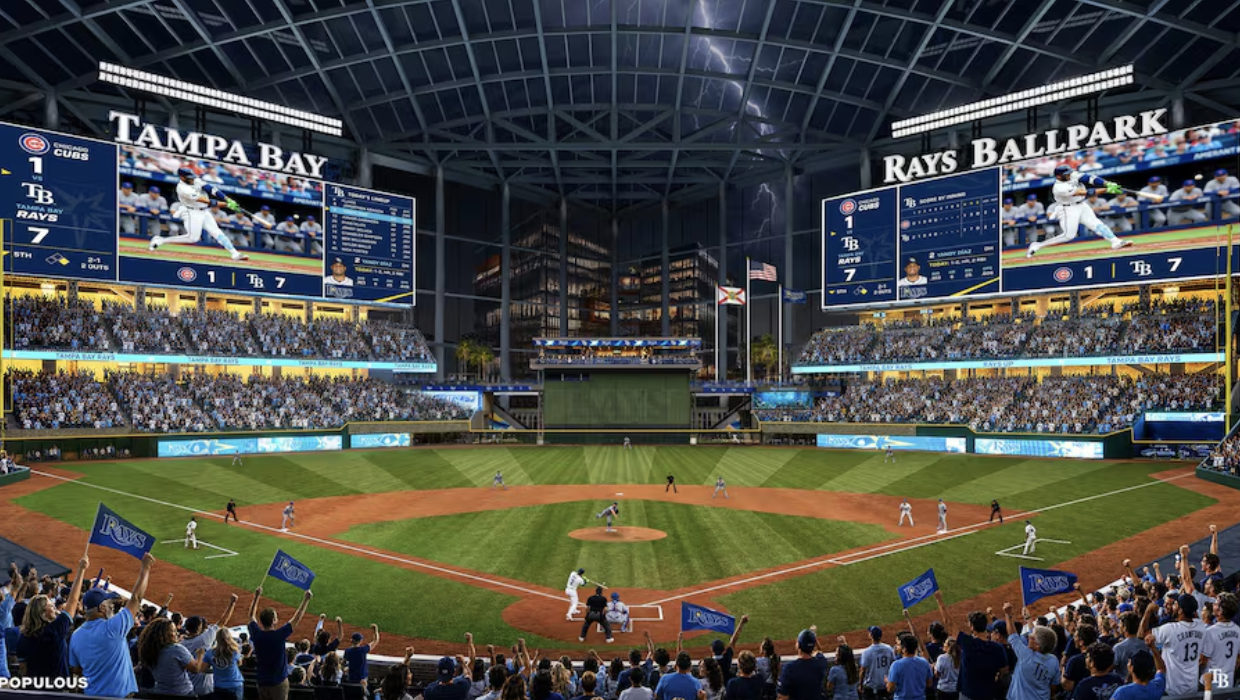
Official Rendering | Populous
The Tampa Bay Rays can, literally, picture their future. Last week on July 8, the team released the latest renderings of their planned downtown St. Petersburg ballpark - a glassy, fixed-roof, indoor-with-sunshine stadium attached to a $2.3 billion mixed-use project, targeted to open in 2029. The images promise light, air, and something that looks more like a modern baseball cathedral than the industrial spaceship they’ve called home since 1998.
But before we get too caught up in the future, it’s worth pausing on what, exactly, they’re leaving behind. Tropicana Field - “the Trop” - wasn’t just a punchline about catwalks and cowbells. It was, arguably, the single most important piece of the franchise’s rise as a pitching factory.
What the Trop actually did
For most of its existence, Tropicana Field behaved like a controlled environment - a place where the Rays could run their pitching experiments with almost no interference from weather or wild swings in run scoring. In the three-year park factor windows leading up to Hurricane Milton, the Trop consistently showed up as a pitcher-leaning yard, shaving roughly 5-8% off run scoring relative to the league average and landing among the most strikeout-friendly environments in the sport.

Tampa Bay Rays Attendance, Stadiums, and Park Factors (Baseball Reference)
Under the dome, balls didn’t carry the same way, outfielders had clean reads, and pitchers could trust that marginal contact would die in front of the warning track instead of sneaking over it. That stability gave the Rays room to lean into high-spin, high-breaking-ball arsenals that might have looked more volatile in a different setting. What a lot of outsiders saw as a weird building with low ceilings and catwalk ground rules, the Rays treated as a stable piece of the puzzle - a home environment they understood well enough to build their pitching strategy around.
The forced experiment at Steinbrenner Field
That experiment ran continuously until October 2024, when Hurricane Milton ripped apart sections of the Trop’s cable-supported fiberglass roof, soaked the interior, and forced a fundamental question: what does Rays pitching look like without its lab? With repairs pushed into 2026 and a broader stadium saga already simmering, the club wound up spending the entire 2025 season at George M. Steinbrenner Field - the Yankees’ spring training park on the other side of the bay.
Steinbrenner, as you’d expect, is modeled as a mini Yankee Stadium: open air, short right-field porch, familiar New York angles shrunk into an 11,000-seat minor league bowl. It came with things Rays pitchers had never had to plan around at home: Gulf Coast heat and humidity, real weather delays (the team’s first-ever home rain delay came in May), and a summer schedule so dicey that MLB reworked the calendar to keep them away from Tampa in July and August.
When the move to Steinbrenner became official, the coverage didn’t just focus on ticket sales and sightlines. Local and national writers flagged the dimensions and conditions - a short right-field porch, the humidity, and what one ballpark tour called “a ballpark not built for summer drama” - as a rough fit for a staff that had been built around elevated fastballs and fly-ball contact under a roof.
But 2025 wasn’t a disaster for the Rays’ staff. They posted a 3.94 ERA on the year, which slots them squarely in the middle of the pack - 15th of 30 clubs. While it didn’t quite match peak Rays teams, given the circumstances, it still reads as a decent proof concept: the Rays’ pitching ideas can survive outside of their preferred dome, even if they don’t dominate.
But it wasn’t nothing: the Baz case
Holding up at the team level doesn’t mean the environment change was costless. If you want a single data point that makes the park story visceral, look no further than Shane Baz.
Baz arrived in the big leagues as one of the purest Rays pitching products: upper-90s velocity, high-spin breaking ball, strikeouts, and the kind of arsenal you’d expect to look nastiest in the controlled conditions of the Trop. In 2025, though, he had to live in Steinbrenner instead.
The numbers tell a pretty sharp story. Baz’s 2025 line with Tampa Bay - 10-12, a 4.87 ERA, 1.33 WHIP, and 176 strikeouts in 166.1 innings - reads more like the stat line of someone absorbing damage for the experiment than the payoff from it. And the home run split is even louder: of the 26 home runs he allowed, 18 came at Steinbrenner Field, where he posted a 5.92 ERA and 1.46 WHIP in 82.1 innings at home. Fantasy write-ups and trade analysis pieces were quick to blame the dimensions and the weather, portraying Baz as a pitcher whose mix was getting beaten up by the setting more than by hitters suddenly figuring him out.
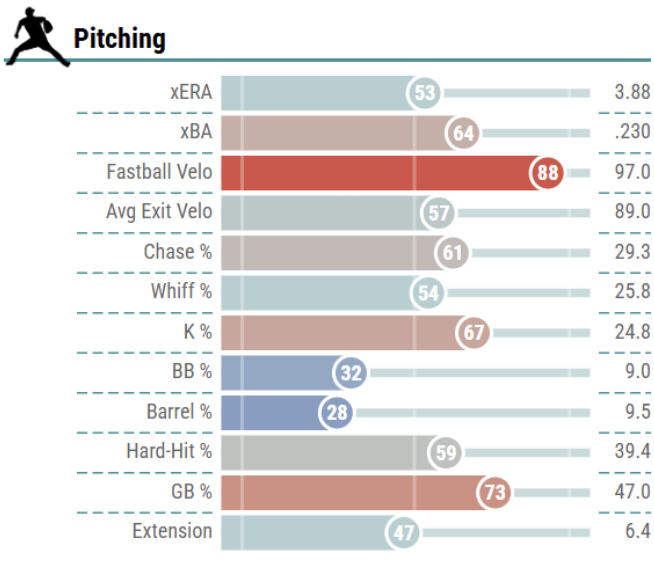
Shane Baz 2025 Pitching Metrics (Baseball Savant)
The implied promise was simple: once Baz got back under a roof - back into the environment the Rays had built their model around - the numbers would surely normalize. The problem is that we’ll never get to see that hypothesis tested. Before the team returned to Tropicana Field in April 2026, Baz was traded to Baltimore without ever re-running the experiment in the renovated dome. A pitcher whose supposed bad luck was blamed on a temporary park became a permanently unresolved case study - an experiment cut off midstream, with the conclusions left to speculation.
The “same” ballpark isn’t the same
Even that speculation rests on a shaky assumption: that “back to the Trop” means “back to the old lab.” Post-Milton repairs didn’t just patch the roof and mop up water. The work amounted to a nearly $60 million overhaul: new slanted roof, new turf, revamped clubhouses, upgraded suites, and a rebuilt audio/visual setup. Ownership changes layered new incentives and aesthetics on top of the physical rebuild.
Early 2026 park factor data - whether you look at Baseball-Reference’s park indexes or Statcast’s venue effects - suggests that the renovated Trop hasn’t simply snapped back into its old role as one of baseball’s most suffocating pitcher parks. Run scoring so far looks closer to neutral than the pre-hurricane three-year window, and the strikeout tilt isn’t quite as pronounced. The building looks familiar on TV, but the way the ball travels, the way the turf plays, and the way air moves under the new roof add up to a meaningfully different run environment.
Which loops us back to the underlying question: if the Rays’ “pitching lab” already changed on them once - first when they were forced outdoors in 2025, then again when they came back to a Trop that looked the same but played differently - how comfortable should we really be treating the ballpark as a fixed backdrop in their pitching story?
What’s next, and what’s still unknown
That uncertainty is the backdrop for those July 8 renderings. The future ballpark is different from any home they’ve experienced so far: an indoor stadium with a fixed roof designed to let in light without surrendering control over temperature and precipitation, dropped into a larger mixed-use development meant to anchor the franchise’s long-term business. The cost - roughly $2.3 billion in total project spending for the ballpark and surrounding district - says this is as much a real-estate play as it is a stadium upgrade.
On paper, it’s easy to imagine a Rays front office trying to specify their next home to behave like a purpose-built lab: roof height tuned to shave off cheap homers, wall angles calibrated to suit the types of pitchers they develop, environmental controls that minimize variance in how the ball moves. It’s equally easy to imagine physics and politics conspiring to give them something messier - a park that looks good in renderings, satisfies non-baseball stakeholders, and lands somewhere mid-pack in actual run prevention.
While construction is years away and the franchise continues to negotiate funding and design details, the new ballpark doesn’t fully exist yet, even as an engineering document; key dimensions and game-related elements are still “under review” in the club’s own description. That leaves a franchise whose modern pitching identity has mostly lived where front-office ideas meet a very specific home environment now having to imagine the next version of that environment without knowing exactly how it will play.
And if you want to see what that uncertainty actually looks like, you don’t have to squint at park-factor tables or architectural renderings. It’s right there in Baz’s line: 4.87 ERA, 1.33 WHIP, 26 home runs, 18 of them in a temp home he was never supposed to pitch in, and a trade before he ever got to test the rebuilt Trop. A franchise that has leaned on its building for two decades has already produced one pitcher whose hypothesis was interrupted mid-experiment. Whether the Rays’ next stadium lets them rebuild that edge or forces them to keep living with those kinds of unresolved stories is not a question the design proposals can answer yet - it’s a verdict we’re going to have to read in the numbers a few years from now.
John D Connolly is a lifelong Red Sox fan now living in Edinburgh, where first pitch usually collides with last call. He writes about the Sox, the Rays, player development, and the thin statistical excuses that keep fans believing. Find him on X at @jdconnolly.