
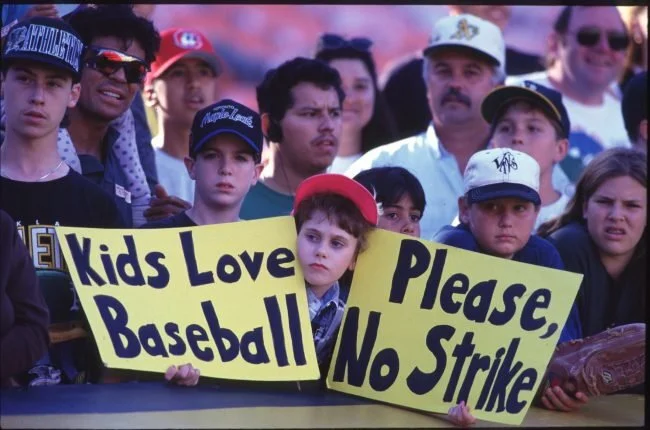
Fans upset during the 1994 strike (Getty Images)
Who are the two parties at odds?
Major League Baseball franchises and the MLB Players Association (the union for MLB players).
When does the current deal expire?
The current CBA governs the 2022–26 seasons and expires at 11:59 p.m. ET on Dec. 1, 2026.
What is the precedent for disagreements in the past?
There have been several strikes (union initiated) and lockouts (owner initiated), but only three which resulted in missed games. In 1972, owners gave into the player demands after 13 days and 86 games. In June 1981, 713 games were cancelled and there was no baseball for the majority of the summer (ended August 10th). The most egregious precedent we have is 1994, when the entire 1994 postseason got cancelled. For the first time in 90 years, there was no World Series champion. There were also some historic individual seasons cut short, such as Tony Gwynn hitting 6 points under .400, or Matt Williams homering at a pace that was going to challenge Roger Maris’s single season HR record.
What happens to the winter meetings and free agency?
Winter Meetings are supposed to start on December 7th, therefore they’ll likely be cancelled if an agreement isn’t made by the 1st. Same goes for free agency; there will be a freeze on contract negotiation on an individual basis, as owners are widely expected to implement a league-wide lockout. That said, the free agent market will be open to all teams from Monday November 2nd at 5:00 ET until the deadline.
MLBPA’s May 27th Offer (source MLBPA)
Major League minimum salary: Raised to $1.5 million starting in 2027.
Expanded 40‑man minimums: Significant increases to ensure all players meet minimum service and pay standards.
Pre‑Arb Performance Bonus Program: Expanded to distribute more money to more players.
Salary arbitration: Broader eligibility and higher contract guarantees for players in arbitration.
Free agency for players with five+ years of service who reach age 30.
Elimination of the qualifying offer and penalties for clubs signing free agents.
Revenue sharing: Guaranteed $240 million annually to every small‑market club, with protections to prioritize winning over profit.
New “Competitive Integrity Tax” for clubs failing minimum payroll benchmarks.
Expanded draft lottery to discourage tanking.
Other benefits:
Expanded rules to combat service‑time manipulation.
Increased “Luxury Tax” thresholds and removal of non‑monetary penalties.
MLB’s October 8th Offer (Multiple Reports)
Cut the schedule from 162 games to 154, beginning in 2029.
A guaranteed off-day every week for player health, along with weekly Monday games showcasing teams and players.
Expand the Division Series from five to seven-game series to match the LCS and World Series, also starting in 2029.
Playoff seed selection: Higher-seeded playoff teams would select their opponents in the first two rounds, with this change proposed to begin in 2027.
More postseason rest: Additional off days during the postseason to reduce daytime games, giving pitchers extra rest and creating more prime-time viewing slots.
The condition: All of the league’s proposals are based on the inclusion of the salary cap and floor MLB originally proposed.
What is the #1 issue between ownership and the MLBPA?
Salary cap by far, I don’t see a CBA happening without some form of one.
My Remarks
The timing is terrible, MLB is both reaching the international market and finding their way into mainstream news again. They seem to be ironing out a lot of the TV deal issues, and this last WBC showed how much growth opportunity there is for MLB given the significant global interest, particularly in Japan and Korea. While MLB has offered a $171.2M payroll floor with their suggested $245.3M cap, it’s hard to envision the union agreeing to a cap number that’s about the same as the current CBT threshold. I like the weekly day off and cutting down to 154 games on the owner side, while I like the minimum salary raise and the competitive integrity tax ideas from the union.
