
The White Sox Bet on Murakami. Were They Playing With House Money?
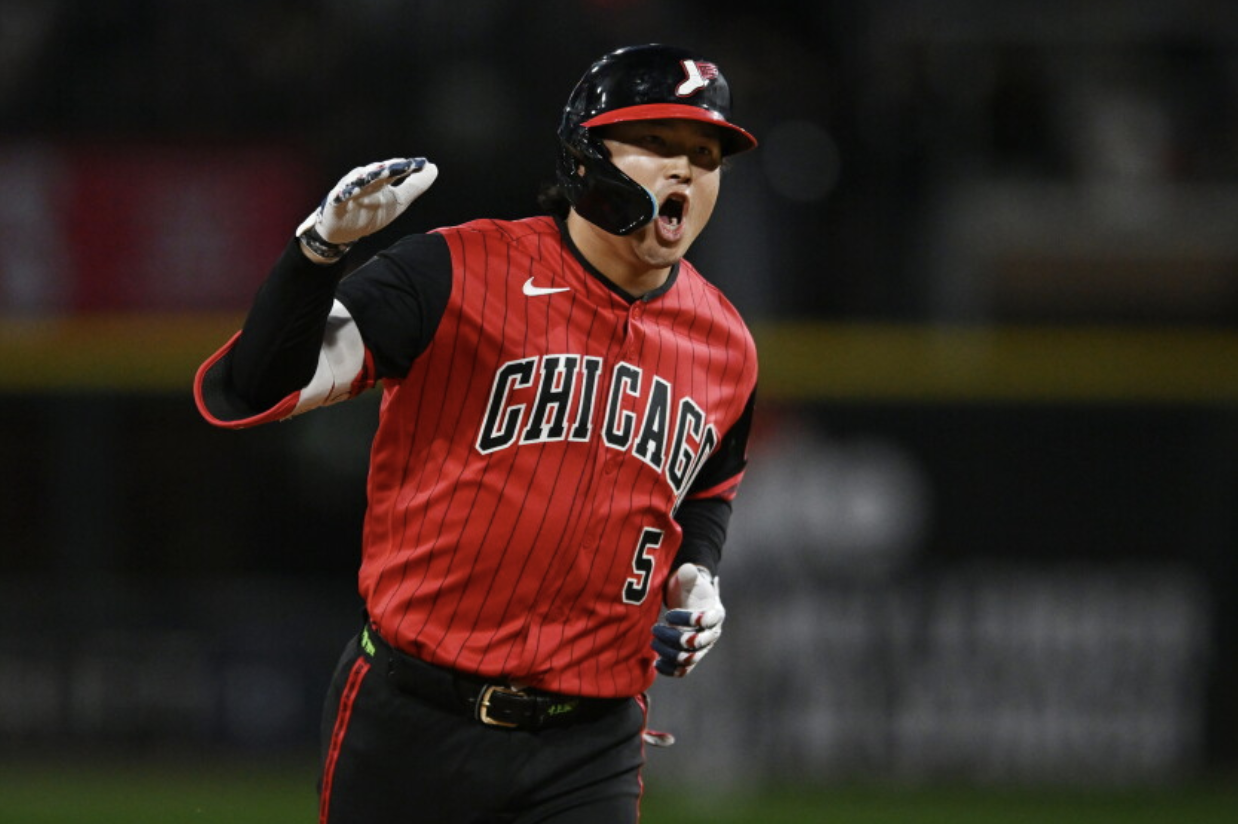
Munetaka Murakami celebrates his solo home run in the first inning Friday against the Rockies. He homered again in the seventh. Paul Beaty/AP
Munetaka Murakami came to Major League Baseball carrying one enormous question with him. Would the power that made him one of the most dangerous hitters in Japan survive against MLB pitching?
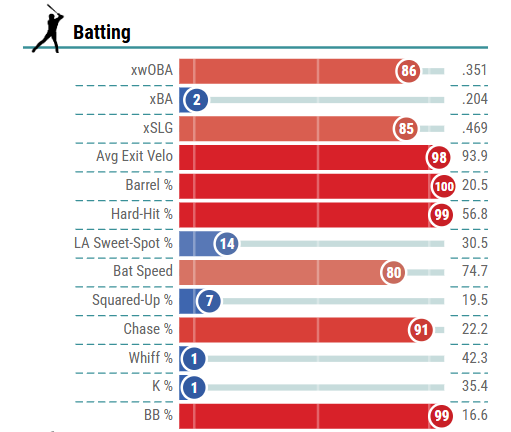
Murakami Hitting Metrics (Baseball Savant)
After 127 games, we can probably stop wondering about that part.
Murakami hit 35 home runs. He slugged .478. He did that while navigating Major League pitching for the first time. He struck out in 35.4 percent of his plate appearances. Out of 553 trips to the plate, 196 ended without the ball ever being put in play. Ouch.
That is where evaluating his first season gets complicated.
The White Sox bet on one of the most fascinating offensive profiles available to them. They have the power. They have patience. They’ve also got a contact problem large enough that it cannot simply be buried underneath 35 home runs. Now that the regular season is finished, Chicago has enough information to start figuring out exactly what it bought. Somehow, Murakami’s .207 batting average might be one of the least interesting parts of the answer.
The power made the trip
Let’s start with what Chicago absolutely needed. Murakami can damage a baseball. His average exit velocity was 93.9 mph. His hard-hit rate finished at 56.8 percent. He barreled 20.5 percent of his batted balls and reached a maximum exit velocity of 114.1 mph. His .478 actual slugging percentage came with a .469 expected slugging percentage. His .356 wOBA was nearly identical to his .351 xwOBA.
Those numbers aren’t only being carried by a handful of home runs.
Murakami hit the ball like a legitimate Major League power hitter; that matters because there was always going to be some translation involved. His greatest season in Japan came in 2022, when he hit 56 home runs and produced a ridiculous 225 wRC+. He walked 19.3 percent of the time while striking out just 20.9 percent. He had massive power. Almost a 20 percent walk rate. A strikeout rate that was completely manageable. That version of Murakami would be terrifying anywhere.
But that version had already started changing before he ever reached Chicago. His strikeout rate climbed to 28.1 percent in 2023, 29.5 percent in 2024 and 28.6 percent in 2025.Then came Major League Baseball and its ability to find a weakness.
The average is not telling us everything
Put it next to 35 home runs, though, and the shape of Murakami’s season starts getting strange. His expected batting average was .204. Not much of a gap with the actual results. This isn’t really a story about a guy getting robbed by great defensive plays or waiting for some massive statistical correction. There is no obvious .260 hitter hiding underneath a miserable run of luck.
The low batting average is part of the profile. Murakami chased only 22.2 percent of pitches outside the strike zone. He also walked 16.6 percent of the time. Those are not the numbers of a hitter blindly hacking his way through Major League pitching. He knows the strike zone.
The problem comes after he decides to swing. Murakami made contact on just 60.2 percent of his swings. Even on pitches inside the strike zone, that number reached only 69.5 percent. When he expanded outside the zone, his contact rate fell to 37.6 percent.
His swinging-strike rate finished at 16.2 percent. You could watch 196 strikeouts and come away saying Murakami needs better plate discipline. But the numbers tell a different story. He needs more contact.
Everything changes after strike one
This might be the most important part of Murakami’s entire first season. When he got ahead 1-0, Murakami produced a 177 wRC+. After falling behind 0-1? He puts up a miserable 74. After 0-2, it dropped to -5. But as we go through, when he reached a 1-2 count, Murakami had a 31 wRC+.
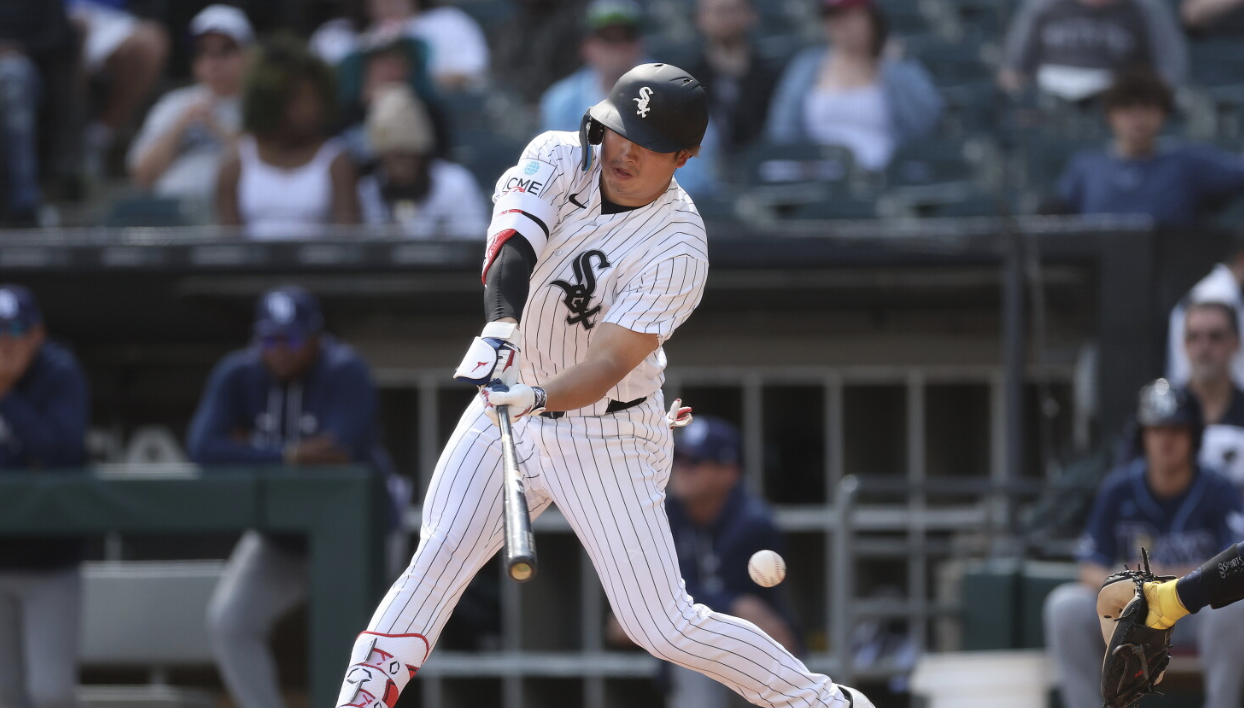
Munetaka Murakami strikes out against the Tampa Bay Rays during the sixth inning at Rate Field on April 16. Michael Reaves/Getty Images
If Murakami survives long enough to reach a full count, he becomes dangerous again. He produced a 196 wRC+ after reaching 3-2, walking in 42.7 percent of those plate appearances. Give Murakami leverage in the count and everything he does well becomes available. He can wait. He can force the pitcher back toward the zone. He can get a pitch that he can destroy. Murakami can control an at-bat and he can recognize pitches. The problem is surviving the part in between.
That first strike has an enormous effect because once Murakami reaches protection counts, the margin for all that patience disappears. He has to cover more pitches. His contact ability gets exposed. Murakami’s next adjustment looks considerably more specific. He has to hit pitches he has already correctly decided to swing at.
The second half looked worse than it actually was
Murakami’s first half was excellent. He hit .232/.371/.540 with a 151 wRC+. In the second half, he dropped to .185/.327/.424 with a 110 wRC+. His strikeout rate climbed from 33.6 to 37.1 percent. By September, it had reached 43.4 percent. That looks like the league finding him and making adjustments.

2026 Munetaka Murakami Season Half Splits (Baseball Reference)
But there is another number sitting underneath the decline. His barrel rate in the first half was 20.0 percent. In the second half, it rose to 20.9 percent. In September, while Murakami was hitting .167 and striking out in more than four out of every ten plate appearances, his barrel rate was 25.0 percent.
That doesn’t erase the strikeouts. If anything, it makes them more frustrating. Pitchers weren’t eliminating Murakami’s ability to do damage, they were reducing how often he got the opportunity to do it. Every time he made contact, the possibility of something violent happening was still there. He simply wasn’t making enough contact.
There may be another clue in where the damage happened
Murakami also did something I wouldn’t have expected when I started digging through the numbers. His best contact wasn’t necessarily the stuff he pulled. On balls hit to the pull side, Murakami averaged 91.6 mph with a 14.6 percent barrel rate. Up the middle, that jumped to a 95.8 mph average exit velocity and a 28.1 percent barrel rate.Going the other way, he averaged 96.1 mph with a 21.3 percent barrel rate.
The opposite-field sample is much smaller, so I’m not ready to build some massive conclusion around it. Still, the shape of the data matters. Murakami does not appear dependent on one tiny slice of the field for his power.
When he squares the baseball, he can hurt you everywhere. That makes the contact issue feel even more important because the reward for solving even part of it could be enormous.
Chicago doesn’t need to turn Murakami into a slap hitter. Nobody should be asking him to trade barrels for singles. The White Sox need more opportunities for the version of Murakami that already exists to actually touch the baseball.
So were the White Sox playing with house money?
That is harder to answer than 35 home runs makes it look. Murakami didn’t arrive as a finished Major League hitter. His final seasons in Japan already showed where the risk lived. The strikeouts were increasing. The possibility that MLB velocity and sequencing could push that weakness even further was sitting right there.
It happened.
But so did everything Chicago hoped would translate. The power survived. The patience survived. The quality of contact survived. Murakami finished his first Major League regular season with a .207 average and still managed a 129 wRC+. That sentence shouldn’t really work. That might be the most important thing Chicago learned.
There are several ways Murakami’s profile can get worse. If the contact rate slips further, there eventually isn’t enough power or patience to compensate.There is also one very obvious way this gets substantially better. He doesn’t need to rediscover 2022. He doesn’t need to cut his strikeout rate to 20 percent. He probably doesn’t even need to become an average contact hitter.
What happens if 35.4 percent becomes 30? What happens if some of those 196 strikeouts become 20 or 30 additional balls in play?
With a 20.5 percent barrel rate and a 56.8 percent hard-hit rate waiting on the other side of the equation, those aren’t empty balls in play. That’s where the White Sox bet gets interesting. 35 home runs gave them an answer. The underlying numbers gave them another question. The second one might matter even more.