
The Rotation That Wouldn’t Stay Dead
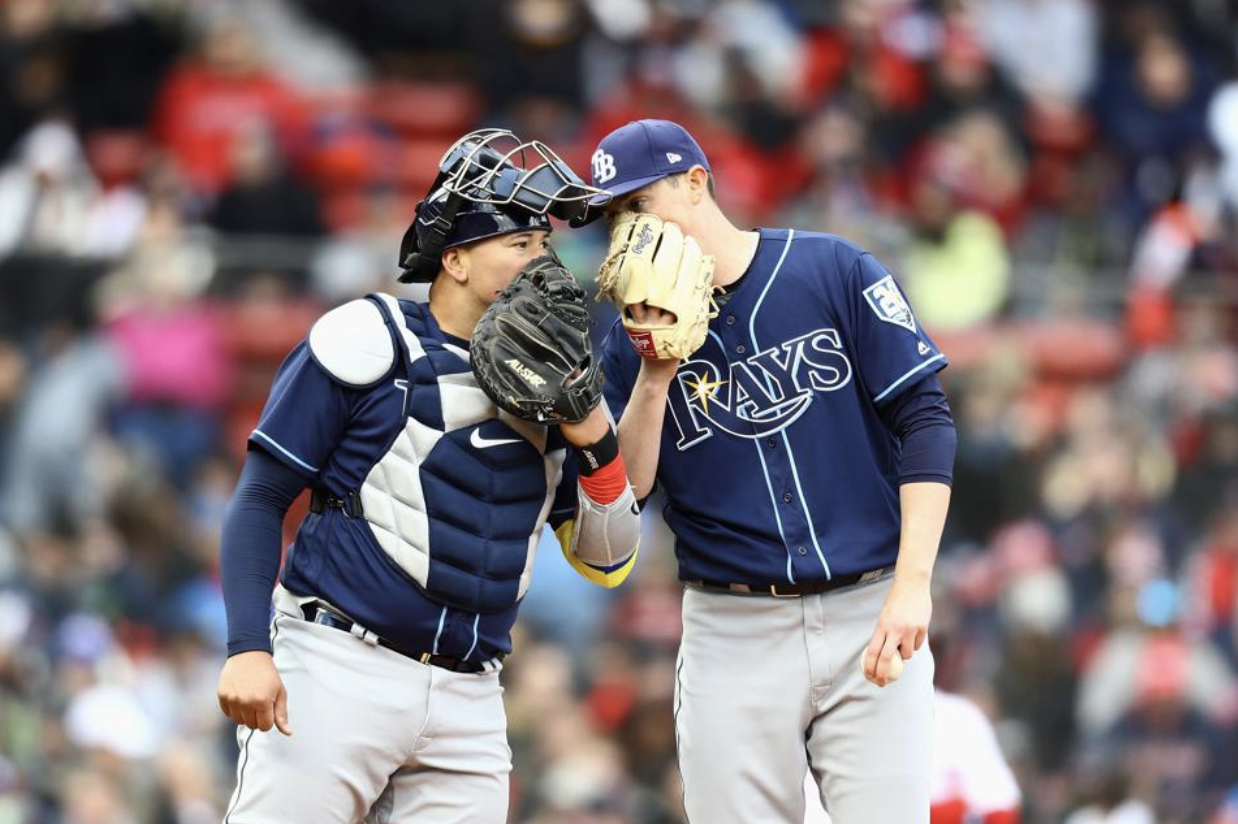
Photo by Omar Rawlings/Getty Images
Last month, I wrote about the way the Trop helped shape the Rays’ pitching identity - and about how Hurricane Milton, Steinbrenner Field, and a rebuilt dome had thrown a monkey wrench into the plan. The next question, naturally, was whether the pitching operation itself could absorb that kind of disruption.
It turns out the bigger disruptor wasn’t the building, it was the people.
Entering the season, it wasn’t unreasonable to think the Rays had finally pushed their pitching model too far. Shane Baz was already gone, traded to Baltimore the previous winter. Taj Bradley had been dealt a few months earlier for Griffin Jax - a bullpen weapon rather than an obvious starting-pitcher replacement. Shane McClanahan was trying to establish himself after two and a half years away from a regular-season MLB appearance. And Ryan Pepiot was considered the safe bet in the pitching plan.
Then the season turned on nearly every one of those pressure points.
As of August 17, the Rays sit 5.5 games ahead of the Yankees atop the AL East with a 74-49 record - the American League’s best record and the second-best mark in baseball. So, the question is no longer whether the Rays have run out of pitchers, but rather what exactly we were measuring when we thought their supply was running thin.
The Rotation That Never Existed
The cleanest version of this year’s Tampa Bay rotation was mostly a figment of our imagination.
Before Opening Day, Tampa Bay had already chosen to turn two young starters into different forms of value. Bradley was sent to Minnesota for Jax, and Baz went to Baltimore for a package of prospects and a draft pick. And that’s when the injuries began.
Pepiot hit the IL with right hip inflammation just before the season kicked off, so Joe Boyle was recalled. That set up a rotation of Drew Rasmussen, Boyle, Steven Matz, Nick Martinez, and McClanahan.
But, of course, that wouldn’t last. Boyle suffered a right elbow strain, Matz hit the IL with left elbow inflammation - returned - then went back with a sprained ankle. McClanahan was sidelined with mid-back tightness, and Jax - who had been stretched into a rotation spot - joined the group on the IL with elbow discomfort.
So, remarkably, one starter never reached Opening Day, three more hit the IL, and a reliever converted to help fill the gaps got hurt, too, leaving Rasmussen and Martinez as the only two constants.
Griffin Jax - The Hinge
When Tampa Bay acquired Jax for Bradley, the immediate logic wasn’t difficult to understand. Jax was an intimidating relief arm, with the command and stuff needed to stabilize late innings. And the trade deadline coverage framed him that way - a bullpen reinforcement piece, not a future starter.
But the Rays had a reason to think bigger. Jax had some starter DNA in him, the durability to handle a meaningful workload, and certainly more pitches than a typical two-pitch reliever. And not to be forgotten, they’d also converted Rasmussen, Jeffrey Springs, and Zack Littell from the bullpen into the starting rotation before.
By the time the Rays started searching to fill the gaps this year, Jax was no longer simply a reliever getting a spot as a starter - he was a different kind of pitcher.
His surface line is respectable - through August 16, he’s tallied a 6-9 record, 3.63 ERA, 1.21 WHIP, 100 strikeouts in 91⅔ innings across 29 appearances and 18 starts. What’s even more relevant is his pitching mix: in 2025, Jax was throwing his sweeper 44% of the time, but that fell to 25% in 2026, while his changeup and sinker became major parts of his arsenal. Even his curveball, which was pretty much non-existent the year before, has been thrown 9% of the time and has turned into a legitimate weapon.
That’s not just a reliever throwing more innings - it’s a pitcher being reconfigured for the number of times a starter has to face a lineup.
Naturally, Jax then became another problem to solve. Testing revealed his elbow issue is not ligament-related. He received an injection and has resumed throwing, but the converted-replacement-starter-needing-a-replacement is the 2026 Rays season in a single sentence.
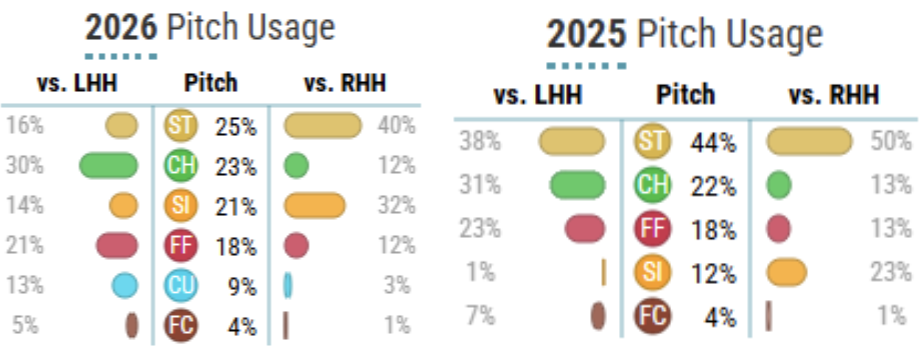
Griffin Jax’s 2026 pitch mix became considerably broader as Tampa Bay stretched him from high-leverage relief work and into the starting rotation. Baseball Savant.
The Machine Was Bigger Than the Pipeline
Before turning Tampa Bay into a case study in organizational wizardry, it’s worth acknowledging the obvious: a lot of this worked because two of the starters were very good and very available.
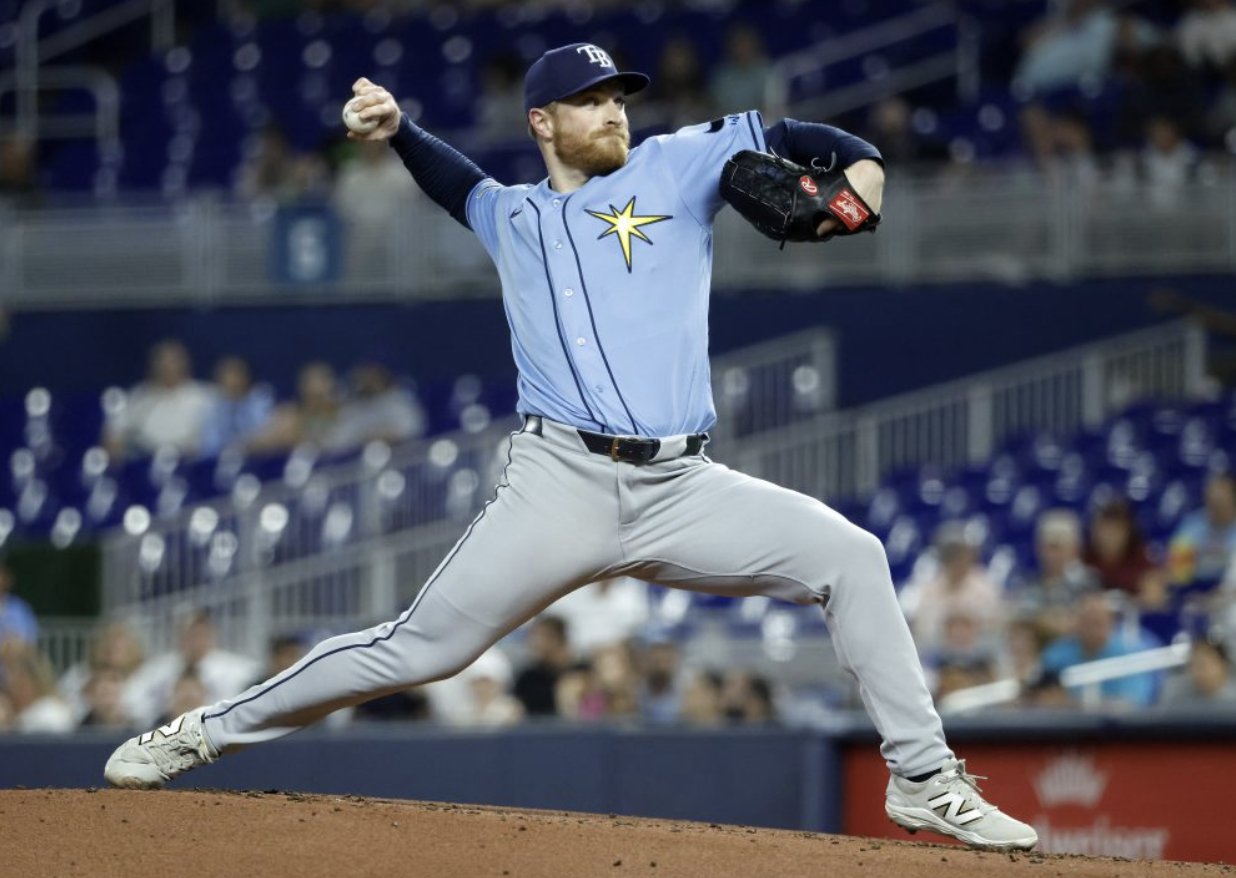
Image credit: Rhona Wise-Imagn Images
Rasmussen has been the stalwart. 2.78 ERA across 129⅓ innings. Martinez has almost matched that with a 2.74 ERA across 138 innings. The important contrast is how they arrived. Rasmussen is the pitcher Tampa Bay transformed from a reliever into a starter. Martinez is the veteran signed on a one-year deal. Two entirely different acquisition and development paths producing the two most stable pieces of the rotation.
And then there’s youngster Ian Seymour, who offers a different answer to the same question. It isn’t his traditional line that tells the story, but rather the 39 appearances and only 10 starts. The ballclub didn’t need to settle whether Seymour was really a starter or reliever. It needed him to cover useful innings whenever the staff needed them. While Jax shows a pitcher changing roles, Seymour offers evidence that the Rays are making the role itself less rigid.
This is where the original depth question needs a rewrite. The farm system didn’t rescue the rotation simply by sending a parade of Triple-A starters up I-275. It provided something else: the transaction currency to acquire Freddy Peralta on August 2, sending the Mets three Top-30 prospects in exchange. That’s still pipeline value, just not the version most people picture when they hear “pitching factory.”
The larger data point here is that despite the Rays moving eight of their Top-30 prospects across four deals, as of this morning, MLB Pipeline ranks their farm system second in all of baseball. Peralta’s early results are almost beside the immediate point. The transaction demonstrates that the prospect reservoir was able to fill the gaps when flexibility wasn’t enough, allowing them to acquire an established starter without hollowing out the prospect pipeline.
Built for 162. October is Different.
On August 7, the Rays starters owned a 3.55 ERA, which was the fourth-best in baseball; however, Jared Greenspan’s article on MLB.com ranked their prospective postseason rotation at sixth. Both can be true at once.
Regular-season success rested on the ability to create usable innings in multiple ways: converting a reliever, deploying a hybrid, cycling through replacements, and using prospect capital as currency. Over 162 games, that redundancy can be transformative.
October rewards something completely different. Off days shrink the rotation. The premium shifts from depth to concentration: whether the top three or four arms are good enough, and healthy enough, to win a short series. Rasmussen and Martinez have looked like the anchors. McClanahan is scheduled to return tonight against Baltimore. The question is whether the top of the rotation can be as formidable in October as the entire staff has been resilient all summer.
A few months ago, the question seemed straightforward: had the Rays finally run out of pitchers? That framing treated pitching depth as an inventory problem - how many starters remained in the system. Tampa Bay has treated it as a capability problem instead: how many different ways can the club produce the innings it needs?
Prospects, converted relievers, swingmen, free agents, and trade chips are all different ways to solve the same problem: finding quality innings. The Rays have spent 2026 showing us that the pieces can change without the pitching collapsing. The more interesting question now isn’t who fills the next vacancy. It’s how Tampa Bay keeps putting itself in position to have another answer.
John D Connolly is a lifelong Red Sox fan now living in Edinburgh, where first pitch usually collides with last call. He writes about the Sox, the Rays, player development, and the thin statistical excuses that keep fans believing. Find him on X at @jdconnolly.