
Baltimore Orioles: Buy Low
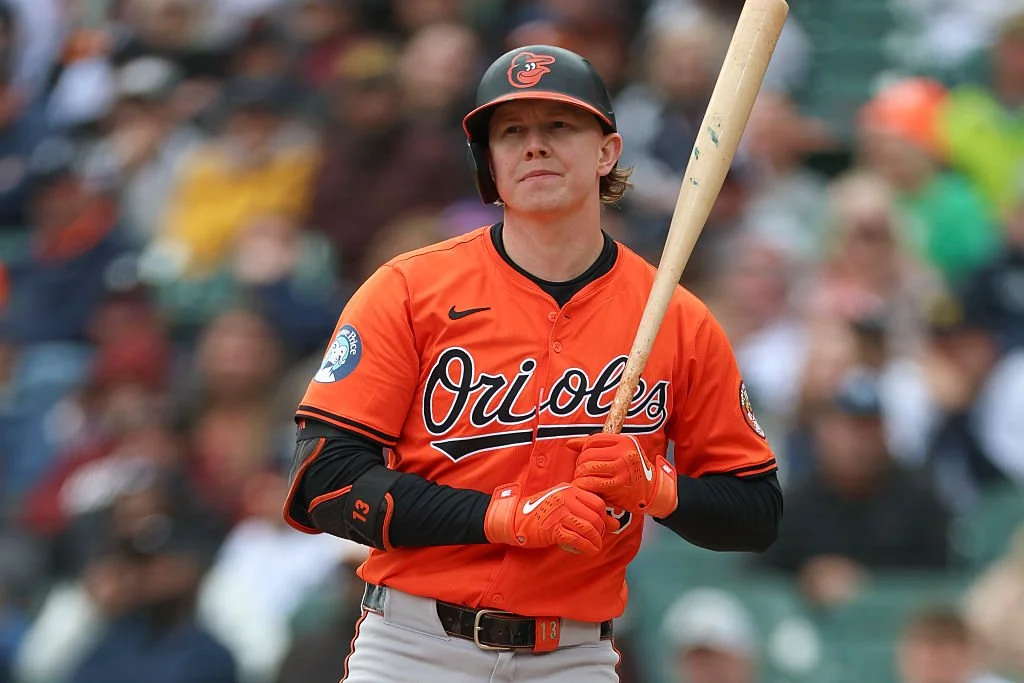
Heston Kjerstad
One of my favorite ways to assess a baseball organization's current and future potential is with a simple exercise: how easy would it be to win the World Series while playing “The Show” or “OOTP” without having to drastically revamp a roster? Besides the Dodgers, how many teams would an average baseball fan pick before landing on the Baltimore Orioles? Between a top 5 farm system, an enviable young core, and some recent playoff appearances, the Orioles are set up nicely for the future. Of the 10 MLB teams with the best farm systems, the Orioles are one of a handful of teams with a chance at the postseason. The Rays, Dodgers, and Brewers have top 3 farm systems as well as being division leaders. The Cardinals have surprised and are above .500 while the Tigers, Guardians, and Twins are within striking distance of a wild card (although all are under .500).
Yet, the Orioles have seen their win total decline every year since 2023, culminating in (potentially) back-to-back losing seasons. Not to mention, they just traded one of their best players.
After a run of winning seasons and playoff appearances from 2012-2016, the team bottomed out to end the 2010s. The futility they’d endure would lead to a highly successful run of draft picks, highlighted in 2019 when they drafted Oregon State catcher Adley Rutschman first overall. In fact, nearly every first round pick from 2017-2021 would make the majors and have produced positive career bWARs thus far.
Format: Draft year, round/pick, player, career bWAR
2017: 1.21 - DL Hall (1.4 bWAR)
2018: 1.11 - Grayson Rodriguez (1.2 bWAR)
2019: 1.01 - Adley Rutschman (16.7 bWAR)
2020: 1.02 - Heston Kjerstad (-1.1 bWAR)
2020: 1.30 - Jordan Westburg (5.1 bWAR)
2021: 1.05 - Colton Cowser (4.4 bWAR)
2022: 1.01 - Jackson Holliday (2.0 bWAR)
Despite the successes the Orioles have had in drafting and developing players in the minor leagues, the organization has had some notable, head-scratching misses regarding roster construction. Most notable was when the team let ace SP Corbin Burnes walk after the 2024 season when the team had a clear need for top-of-the-rotation starting pitching. They made “win-now” moves when they signed oft-injured OF Tyler O’Neill before the 2024 season and acquired OF Taylor Ward before the 2026 season to man the corner OF spots. At face value, these were prudent moves to improve the lineup but they came at the expense of blocking top 40 prospect Kjerstad while he was in the high minors. Additionally, the Orioles chose to play league average 1B Ryan Mountcastle (cumulative 106 OPS+ since 2022) as their starter before signing All-Pro 1B Pete Alonso to a 5-year/$155 million contract this past off-season. These moves further blocked Kjerstad from finding any consistent playing time in the majors or having any sort of long leash to acclimate to major league pitching. These moves signaled the team wanted to win now, which is exciting for a fan base, but hindered the development of the former 2nd overall pick. Kjerstad will be 28 years old on Opening Day 2027 and has appeared in 106 MLB games.
Recently, the team traded away the face of the franchise and former 1.01 pick, catcher Adley Rutschman. Rutschman, 28 years old, is regarded as one of the best, most well-rounded catchers in the game and isn’t slated to become a free agent until after the 2027 season. This left a glaring hole behind the plate for the O’s, as former elite hitting prospect Samuel Basallo is scouted as a hit-over-defense catcher (who may end up at DH/1B) and Carlos Narváez, a MLB catcher acquired in the Rutschman trade, has produced -0.9 bWAR this year (although he accrued 2.8 bWAR in 2025 with the Red Sox).
Some Stalled Progress From the Core
The Orioles have a rock-solid foundation with catcher Samuel Basallo (21 years old), SS Gunnar Henderson (25 years old), 2B/3B Jordan Westburg (27 years old), 2B Jackson Holliday (22 years old), 3B/1B Coby Mayo (24 years old), OF Colton Cowser (26 years old), OF Dylan Beavers (24 years old), SP Shane Baz (27 years old), SP Brandon Young (27 years old), SP Trevor Rogers (28 years old), and recently extended SP Kyle Bradish (29 years old). The starting pitchers are expected to all accrue at least 2.0 bWAR by season’s end with potential to reach another level in years to come.
As we know, young players' progress is not linear and it can become a rollercoaster with their development. While all of these hitters are former top-rated prospects and most have had success at the major league level, almost all of them are experiencing down years from expectations.
Westburg has played in 260 games since he broke into the league in 2023. Yet, since 2024, he’s played in 192 of 486 games (39.5% of total games). When he’s played, he’s been good. From 2024-2025 (he will miss the entire 2026 season due to injury), Westburg averaged 3.2 bWAR per 162 games, 121 OPS+ with 162 game averages yielding 30 HRs and 30 2Bs, not to mention decent infield defense and versatility. Westburg will be 28 years old on Opening Day 2027.
Cowser provides solid outfield defense and is capable of handling CF duties. But, since producing 2.8 bWAR and 120 OPS+ as a 24 yo in 2024, he’s averaged 1.8 bWAR/season with a 87 OPS+. He has a 92 OPS+ this year. Also, he’s batted poorly against left-handed pitching, slashing .184/.279/.263/.542 in 38 ABs this season. Cowser will be 27 years old on Opening Day 2027.
Beavers surprised many baseball writers and flew up prospect boards last year. He was promoted to the majors and made his mark. In 35 MLB games, he slashed .227/.375/.400/.775 which was good for a 120 OPS+ as a 23 year old. He was expected to take a jump this year but 2026 has been very disappointing. In 70 games, he’s produced a -0.7 bWAR and a 87 OPS+. With just 105 MLB games on his resume, the sky remains the limit for Beavers, who will spend most of the 2027 season as a 26 year old.
Kjerstad was a top 40 prospect as recently as 2024. He has spent much of the 2026 season injured and unable to crush AAA pitching. As stated, there aren’t enough at-bats in Baltimore, as Kjerstad’s defensive options, LF, RF, 1B, & DH, have entrenched or established veterans. With the trade of Ward, there’s suddenly more of an opportunity, if he can seize it.
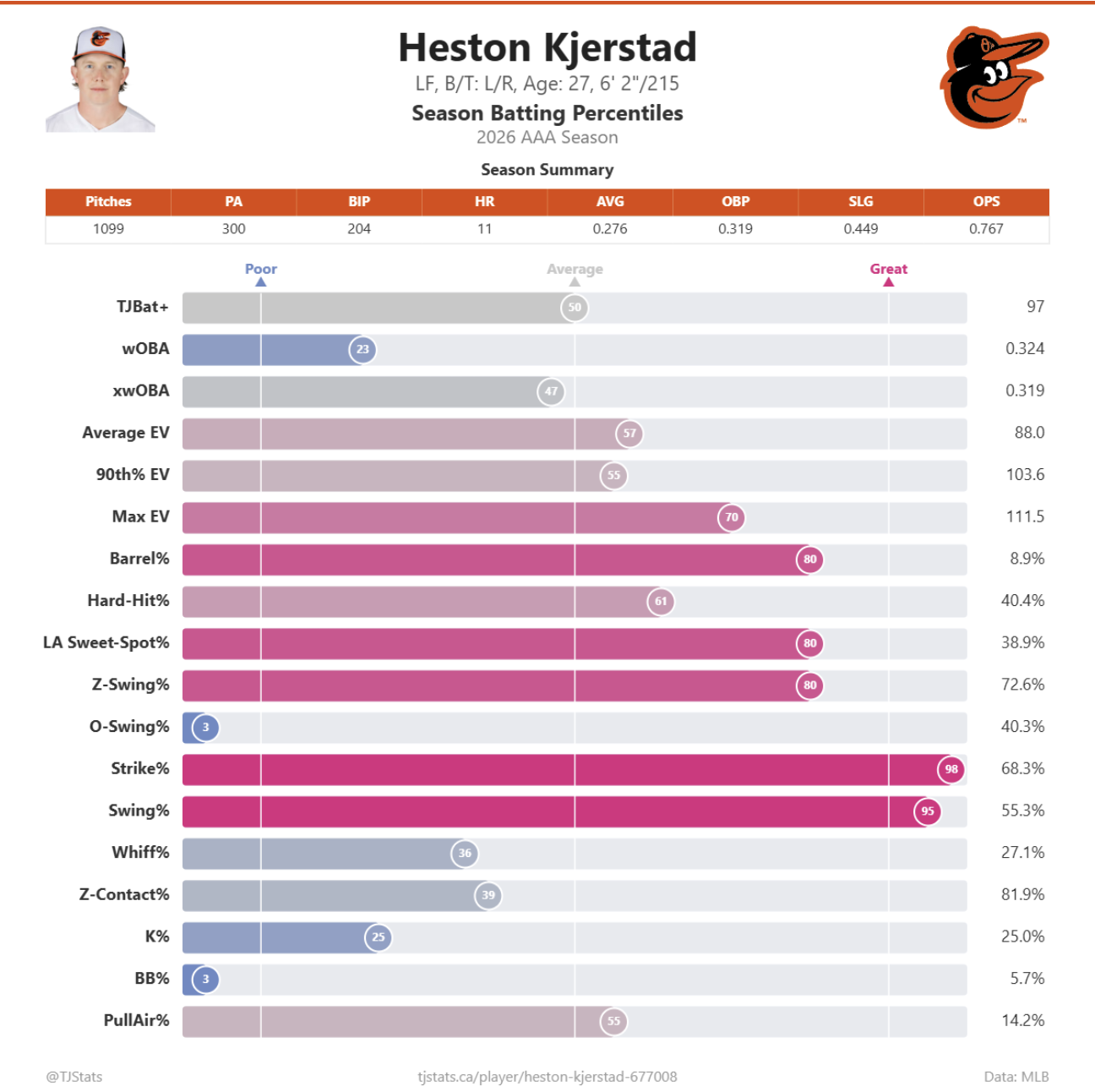
Kjerstad’s AAA stats via TJ Stats
Henderson was an MVP candidate in 2024, when he had a 155 OPS+ and accrued a massive 8.8 bWAR as a 23 year old, while playing a darn decent shortstop defensively. 2025 saw a bit of a regression, with a 121 OPS+ and 5.4 bWAR, which was in line with his age-22 season during the 2023 season. In fantasy circles, Henderson was viewed as a top 15 asset coming into the 2026 season. Not only has his defense taken a step back (he has a negative DRS for the first time in his career), he’s seen his offense regress. To date, he’s produced a below league average OPS+ (98 OPS+) with 1.8 bWAR.
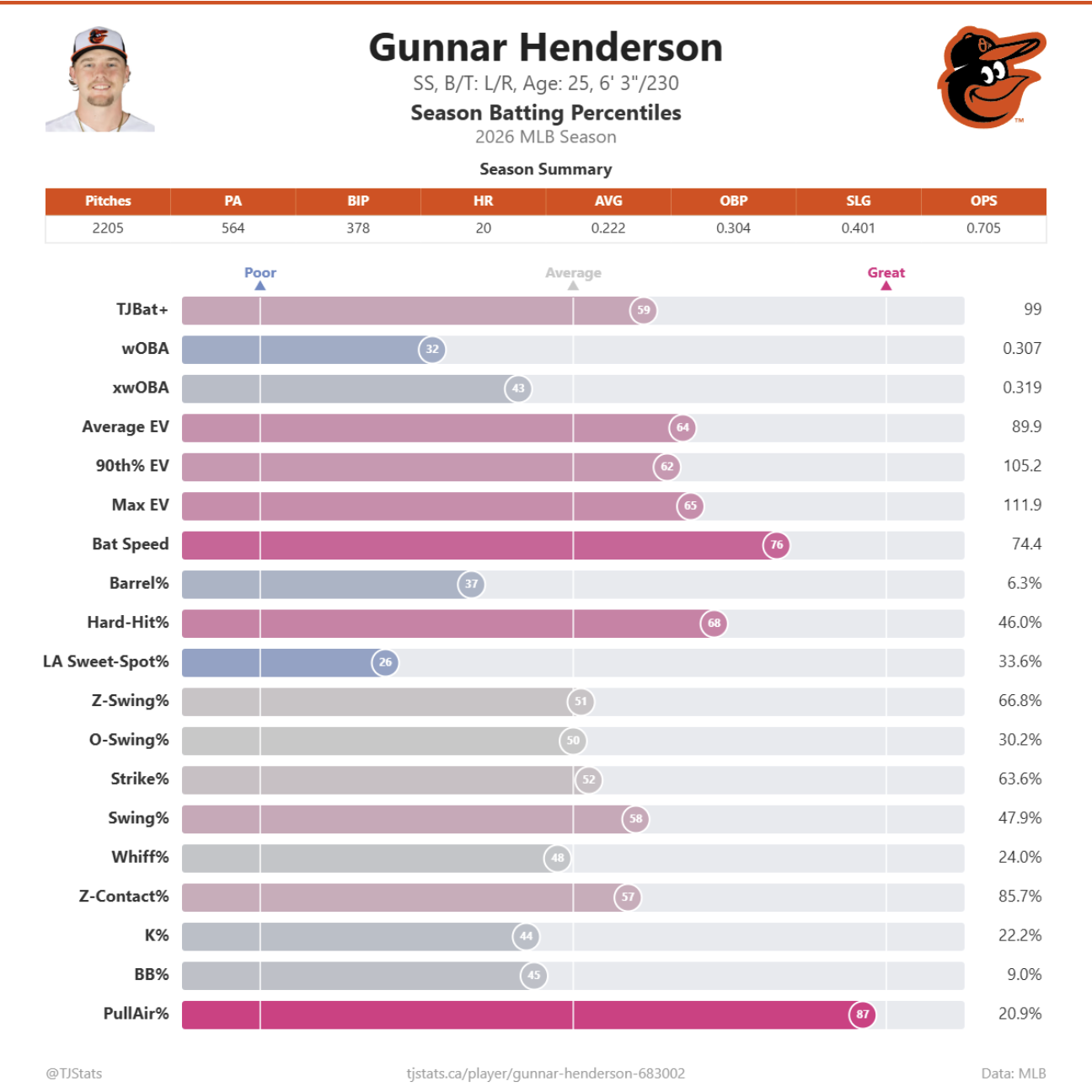
Henderson’s stats via TJ Stats
I’m not here to diagnose what is wrong with Henderson (or many other Team USA WBC batters, that’s another article), or Henderson’s teammates. Huge expectations can become burdensome and baseball players are, after all, human. But it goes without saying that a big reason for the Orioles regression has been the regression of the middle of their lineup. The O’s rank 16th in the majors in OPS.
Help On The Way
While most of the Orioles’ well-regarded position player prospects are in the lower minors, the Orioles have a plethora of elite pitching prospects in the high minors. Borderline top 100 prospect Trey Gibson (7.36 ERA in 33 innings) has made several starts in the majors this year (albeit without much success so far), and Cade Povich has pitched decently this year (4.45 ERA in 28.1 innings). The Orioles feature five pitching prospects ranked in the top 175 prospect aggregate list, with Michael Forret (#120 prospect aggregate ranking) and Luis De León (#170 prospect) pitching in AAA. Newly acquired Anthony Eyanson (#38 prospect), Joseph Dzierwa (#83 prospect), and Caden Hunter (#134 prospect) are all pitching well in AA. I’d expect them all to see some time in the majors at various points of the 2027 season.
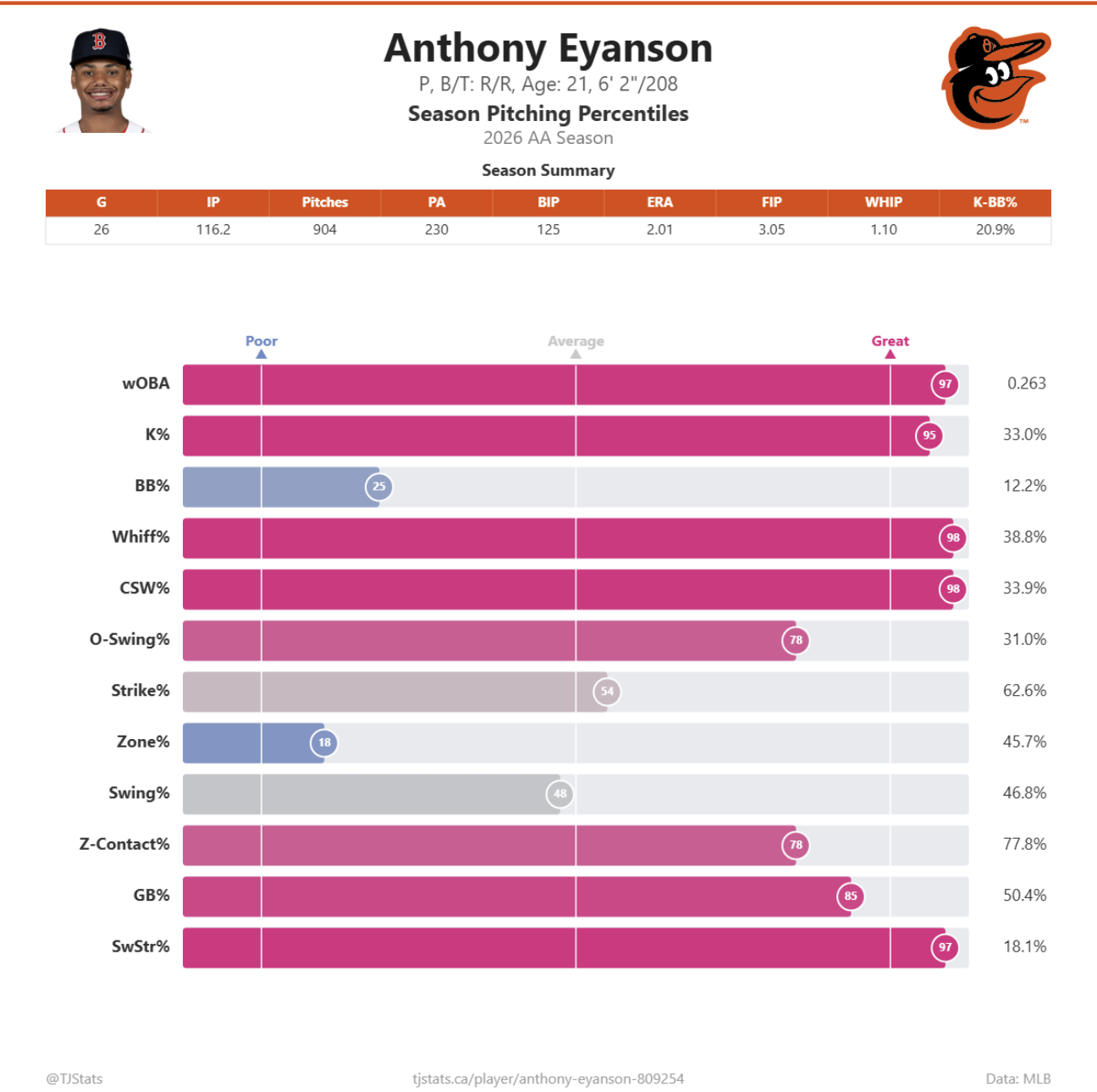
Top prospect Eyanson’s AA stats via TJ Stats
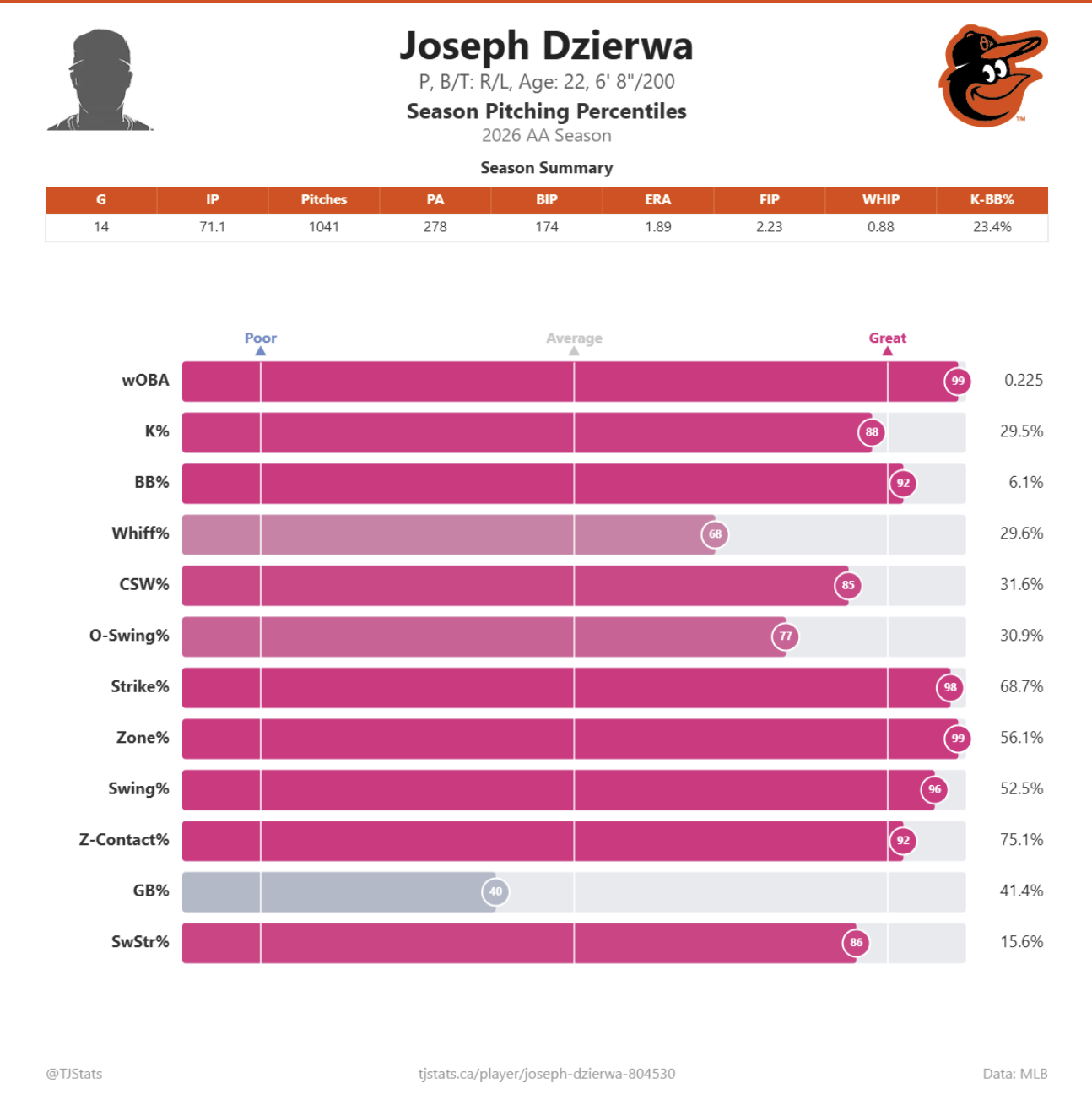
Prospect Dzierwa’s AA stats via TJ Stats
Conclusion
Contention windows close MUCH faster than anyone hopes. Many factors play a role, like team health, chemistry, player happiness in said organization, and other teams improving in their own division/league. In 2021, the Orioles finished 52-110, the second most losses the team has had since WW2, only behind the 2018 Orioles. Then, in 2022, rookie catcher Rutschman debuted and contributed 5.4 bWAR and helped the Orioles finish the year with 83 wins and 79 losses, an improvement of almost 30 wins. In 2023, the team improved by 18 games, finishing 101-61 but were swept in the ALDS by the Rangers. So, in a two year span, the team improved by nearly 50 wins. The future appeared immensely bright and the title window just seemed to propped wide open. But since the end of the 2023 season, the Orioles have seen a steady decline in wins, finishing with a respectable 91 wins in 2024 (although they were swept by the Royals in the wild card round), then an underwhelming 75 wins in 2025, and currently an approximate 79-80 win pace this year. These Orioles are not dead in the water. They did just win 3 out of 4 against the AL leading Rays while in Tampa Bay. The O’s sit 3 games below .500 but have a challenging schedule the rest of the year. And yet, they are still in the thick of the AL wild card race.
If I’m a Wall Street guy playing the market, I’m taking the Orioles as a buy low and anticipating a good return on the investment.
Michael L. Sküpin (Substack profile) is a grizzled millennial husband/dad who loves talking baseball, football, hockey, basketball, college sports, sports business, fantasy sports, and many other sports. Fandoms include Detroit, Philadelphia, & Indianapolis. Also, happy to chat about advocacy, mental health, social justice, and life.